Understanding Sitting Angles and Lumbar Pressure
If your lower back begins to feel tight, fatigued, or under pressure as the workday progresses, it’s important to understand that this response is neither imagined nor a reflection of poor posture habits. In most cases, it is a predictable outcome of how the body is positioned for prolonged sitting.
Lower back discomfort during desk work is rarely about effort. It is primarily about angles—specifically, how high you are seated, the angle created at your hips, and how your feet are supported on the floor. Together, these factors determine how your weight is distributed through the pelvis and into the lumbar spine.
When these angles fall outside of a supportive range, the body compensates. Muscles work harder to stabilize the pelvis, spinal pressure increases, and fatigue accumulates gradually throughout the day. When the angles are properly supported, however, load is distributed more evenly, muscular effort decreases, and sitting becomes significantly easier to tolerate over time.
Understanding how sitting angles influence lumbar pressure is a critical step toward improving desk comfort. In the sections that follow, we’ll examine how seat height, hip angle, and foot positioning affect spinal loading—and what actually helps reduce lower back pressure across the workday.
This article draws on a comprehensive review of scientific literature evaluating lumbar spine load and intradiscal pressure in relation to sitting angles.

Why Sitting Comfort Is About Angles, Not Effort
Sitting discomfort is often framed as a posture issue—something that can be corrected with greater awareness, frequent reminders, or increased muscular effort. While posture cues may offer short-term improvements, they rarely address the underlying cause of sustained discomfort during desk work.
Sitting is not a strength challenge, nor should it require constant self-correction. It is fundamentally a load-management issue.
When you sit, your spine must support the weight of your upper body in a largely static position. Unlike standing or moving, where load shifts naturally, seated work concentrates pressure for extended periods. How that pressure is distributed depends almost entirely on your sitting angles—specifically the relationship between your seat height, hip position, and foot support.
Even small deviations from supportive angles can have a meaningful impact over time. Sitting slightly too low can encourage posterior pelvic tilt. A modestly closed hip angle can flatten the natural curve of the lower back. Unsupported feet can reduce pelvic stability. Individually, these changes may feel minor. Collectively, they increase lumbar pressure and accelerate muscular fatigue.
This is why sitting may feel comfortable at first, only to become increasingly demanding as the hours pass. The issue is not a lack of discipline or endurance—it is the cumulative effect of unmanaged load.
By focusing on angles rather than effort, it becomes possible to reduce the demands placed on the lower back and create a sitting experience that remains comfortable and sustainable throughout the workday.

What Is Lumbar Pressure—and Why Sitting Increases It
Lumbar pressure refers to the compressive forces acting on the lower spine, including the intervertebral discs, facet joints, and the surrounding muscles that help stabilize the area. These structures are designed to tolerate load—but they are also sensitive to how that load is applied and for how long.
When you are standing or moving throughout the day, spinal load is constantly changing. Muscles engage and release in cycles, posture adjusts naturally, and pressure is redistributed across different tissues. This dynamic environment allows the spine to recover repeatedly, even under relatively high loads.
Sitting, by contrast, creates a much more sustained loading pattern. Movement is reduced, positions are held for longer periods, and the same areas of the spine continue to bear weight without meaningful relief. When small alignment issues are present—such as a rounded lower back or an unstable pelvis—those issues remain in place for hours at a time, allowing pressure to accumulate.
This does not mean that sitting is inherently harmful. Rather, unsupported sitting increases spinal compression, particularly when the pelvis drifts away from a neutral position and the lumbar spine loses its natural curvature. In these conditions, discs experience greater compressive stress, muscles remain engaged longer than intended, and fatigue becomes more likely as the workday progresses.
Understanding lumbar pressure as a function of sustained load—rather than a sudden injury—helps explain why discomfort often develops gradually and why support and alignment play such a critical role in long-term sitting comfort.

Why Sitting Angles Matter More Than “Good Posture”
Advice like “sit up straight” is well intentioned, but it often oversimplifies the problem. While posture cues may help momentarily, they rarely address why sitting becomes uncomfortable over time. The concept of 'proper posture' is frequently recommended to prevent and manage lower back pain, but simply aiming for proper posture is often insufficient for achieving long-term comfort.
Posture is something you actively maintain.
Angles are something your body passively relies on.
If your sitting angles do not provide adequate structural support, your muscles are forced to do the work of stability all day long. The lower back, in particular, is often recruited to compensate for missing support elsewhere. Over time, this constant muscular engagement leads to fatigue, increased lumbar pressure, and reduced sitting tolerance.
The most influential sitting angles are not subtle posture details—they are structural relationships that determine how your body settles into the chair. Three angles, in particular, play a central role:
-
Seat height, which affects how the pelvis is positioned relative to the spine
-
Hip angle, which influences pelvic tilt and lumbar curvature
-
Foot positioning, which determines how stable the pelvis remains during prolonged sitting
Together, these angles decide whether the pelvis stays balanced and supported, or whether the lower back is required to compensate for instability. When the pelvis is stable, the spine can maintain its natural alignment with minimal effort. When it is not, the lumbar region absorbs more load than it was designed to handle for extended periods.
Focusing on sitting angles rather than posture correction shifts the goal from constant effort to sustainable support—allowing the body to remain comfortable without ongoing muscular strain.

Risks of Prolonged Sitting
Prolonged sitting is more than just a source of temporary discomfort—it can contribute to a range of health problems that extend well beyond the lower back. When you remain in the same position for extended periods, especially with poor sitting posture, the risk of lower back strain, neck pain, and shoulder discomfort increases significantly. Slouching, leaning forward, or failing to maintain proper foot positioning can place excessive pressure on the spinal discs, leading to back pain and, over time, potential long-term damage to the lumbar spine.
Beyond musculoskeletal issues, sitting for long stretches can also restrict blood flow to the legs and feet. This can result in numbness, tingling, and swelling, making it harder to rest comfortably and increasing the risk of circulatory problems. Without proper ergonomics—such as lumbar support, sitting upright, and keeping the feet flat or supported—these effects are amplified, placing additional strain on the back muscles and spinal structures.
To reduce these risks, it’s essential to prioritize a sitting posture that supports the natural curves of the spine, ensures proper foot positioning, and incorporates lumbar support. Regular movement and mindful adjustments to your setup can help alleviate the negative effects of prolonged sitting, supporting both lower back health and overall well-being.

Seat Height and Lumbar Pressure: Where Load Begins
Seat height is one of the most influential—and most commonly overlooked—factors affecting lumbar pressure during sitting. It sets the foundation for how the pelvis is positioned, which in turn determines how load is transferred into the lower spine.
When the seat is too high, the opposite problem can occur. The feet may lose consistent contact with the floor, reducing the base of support. This can result in dangling feet, which negatively affects body alignment and comfort. Using a foot rest can help restore proper support and prevent the issues associated with dangling feet.
How Seat Height Changes Pelvic Position
The height of your seat directly influences whether your pelvis can settle into a neutral, supported position.
When the seat is too low, the hips drop below the level of the knees. This encourages the pelvis to roll backward, flattening the natural curve of the lower back. As the lumbar spine rounds, compressive forces shift from being evenly distributed to becoming more concentrated in specific areas of the spine.
When the seat is too high, the opposite problem can occur. The feet may lose consistent contact with the floor, reducing the base of support. Without stable foot contact, the pelvis becomes less anchored, increasing subtle movement and instability throughout the sitting period.
Although these two scenarios look different, they lead to a similar outcome: increased lumbar pressure. In one case, pressure rises due to altered spinal alignment; in the other, it increases due to reduced pelvic stability.
Why Incorrect Seat Height Increases Disc and Muscle Load
When the pelvis is not supported in a neutral position, the lower back is forced to compensate. Lumbar discs absorb greater compressive forces as spinal alignment shifts, while surrounding muscles remain engaged longer to maintain balance and control.
This combination of increased disc loading and sustained muscular effort accelerates fatigue. Importantly, this fatigue can develop even in the absence of sharp or immediate pain, which is why discomfort often appears gradually as the workday progresses.
This is also why seat support plays such a critical role in sitting comfort. By helping maintain appropriate seat height and pelvic positioning over time, effective seat support reduces unnecessary strain on both the discs and the muscles of the lower back—making prolonged sitting far more sustainable. Using back support can further help maintain proper spinal alignment and comfort during prolonged sitting.

Hip Angle: The Hidden Driver of Lower Back Fatigue
While seat height often receives the most attention, hip angle plays an equally important—and frequently underestimated—role in lower back comfort during sitting. The position of the hips strongly influences how the pelvis and lumbar spine behave under sustained load.
Many desk environments unintentionally promote closed hip angles, particularly over time as seat cushions compress and sitting positions subtly change throughout the day. A closed hip angle can also cause individuals to slouch forward, further increasing lumbar pressure and discomfort.
What Hip Angle Means in Sitting
Your hip angle refers to the angle formed between your torso and your thighs while seated. This angle determines how freely the pelvis can maintain its natural position.
A closed hip angle occurs when the thighs are angled sharply upward toward the torso. This is common in desk setups where the seat is low, the cushion compresses unevenly, or the chair design restricts pelvic movement.
A more open hip angle occurs when the thighs slope gently downward from the hips. This position allows the pelvis to settle more naturally and reduces the tendency for the lower back to round.
Many desk environments unintentionally promote closed hip angles, particularly over time as seat cushions compress and sitting positions subtly change throughout the day.
How Closed Hip Angles Increase Lumbar Compression
As hip flexion increases, the pelvis is encouraged to rotate backward. This posterior pelvic rotation flattens the natural curve of the lumbar spine, shifting how load is distributed through the lower back.
When the lumbar curve is reduced:
-
Compressive forces on the spinal discs increase
-
Muscular effort is required to maintain stability
-
Fatigue accumulates more quickly
This helps explain why lower back pressure can persist even when someone appears to be “sitting upright.” Shoulder position alone does not determine spinal loading. In many cases, it is the hip angle—quietly influencing pelvic orientation—that drives increased lumbar compression and fatigue. Poor hip angle can also lead to misalignment of the head and neck, further contributing to discomfort.
By addressing hip angle alongside seat height and foot support, it becomes possible to reduce unnecessary spinal load and improve sitting endurance without constant posture correction.

Foot Positioning and Its Role in Lumbar Stability
Foot positioning plays a critical role in sitting comfort, yet it is often overlooked when addressing lower back discomfort. Maintaining proper foot positioning and using supportive tools like footrests offer significant ergonomic benefits, such as promoting healthier posture and reducing lumbar pressure. Even while seated, the body relies on a stable base of support to maintain pelvic alignment and reduce unnecessary strain on the spine.
Why Feet Control Pelvic Stability
Your feet function as the foundation of your seated posture. When they are firmly supported, they help anchor the pelvis and provide a stable reference point for the rest of the body.
When foot support is compromised—such as when the feet are dangling, tucked unevenly beneath the chair, or resting lightly without full contact—the pelvis loses stability. In response, subtle shifts occur as the body searches for balance. These small movements may go unnoticed, but they increase the demand placed on the lower back over time.
Without a stable base, pressure is no longer managed locally at the level of the feet and pelvis. Instead, it is transferred upward, where the lumbar spine is often forced to absorb the excess load.
Many users report improved sitting posture and comfort after incorporating ergonomic footrests into their setups.
How Poor Foot Support Transfers Pressure Up the Spine
In the absence of consistent foot contact, the pelvis tends to shift more frequently throughout the workday. Core muscles must remain engaged to compensate for this instability, leading to earlier fatigue. As those muscles tire, the lumbar region increasingly takes on the role of stabilizer, resulting in sustained muscular tension and elevated spinal pressure.
Providing proper foot support helps interrupt this cycle. A well-designed footrest, such as the Serenform Axis Footrest, restores a stable base of support, allowing the pelvis to remain more settled and the spine to maintain alignment with less effort. By reducing unnecessary movement and muscular compensation, foot support plays a key role in maintaining lumbar stability during prolonged sitting. Workplace ergonomics, including the use of ergonomic tools like footrests, is essential for promoting comfort and reducing back pain in office environments.

How Sitting Angles Compound Pressure Over the Workday
One of the most common patterns in desk-related discomfort is that symptoms rarely appear immediately. Sitting may feel comfortable at the start of the day, only to become progressively more difficult to tolerate as hours pass. This delay is not accidental—it reflects how sustained load accumulates over time.
When sitting angles are even slightly unsupportive, the body is able to compensate initially. Muscles engage to stabilize the pelvis, alignment is maintained through effort, and lumbar pressure remains within a tolerable range. However, as the workday continues, these compensatory strategies become increasingly demanding.
The progression often looks like this:
| Factor |
Early in the Day | Later in the Day |
|---|---|---|
| Muscle effort | Manageable | Fatigued |
| Pelvic stability | Relatively steady | Gradually drifting |
| Lumbar pressure | Tolerable |
Accumulated |
| Sitting tolerance | High | Reduced |
This progression does not reflect weakness or poor habits. It reflects time under load. Muscles are not designed to maintain static support indefinitely, especially when they are compensating for suboptimal angles. As fatigue sets in, posture becomes harder to sustain, pelvic position drifts, and pressure in the lumbar spine increases further.
This is why relying on posture awareness alone often falls short. Without structural support to maintain favorable sitting angles, even “good posture” becomes difficult to hold by the end of the day. Addressing how load is managed over time—not just how you sit in the moment—is key to improving long-term sitting comfort.
Effectively managing lumbar pressure and preventing discomfort requires a comprehensive approach that includes ergonomic practices, supportive tools, and regular movement.

Why Adjustments Alone Often Don’t Hold
Adjusting your chair, desk height, or sitting position can create an immediate improvement in comfort. Many people experience brief relief after making these changes, only to notice that discomfort returns an hour or two later. This pattern is common and largely expected.
The reason is not that the adjustment was incorrect—it is that adjustments alone do not address how the body responds over time.
As the workday progresses, several predictable changes occur. Muscles that were initially able to support posture begin to fatigue. Seat cushions compress, subtly altering seat height and pelvic position. The pelvis itself gradually shifts as the body seeks relief from sustained pressure. Together, these factors cause sitting angles to drift, even when the initial setup was sound.
Adjustments are effective for reaching a more supportive position. However, they rely on ongoing muscular effort and material consistency to maintain that position. Without additional support, the body is left to compensate, and the original benefits fade.
This is where seat and foot support function best as a system. By reinforcing stable sitting angles and reducing the need for constant muscular correction, support helps preserve alignment throughout the day. Rather than repeatedly adjusting, the body is able to remain settled, making sitting more comfortable and sustainable over longer periods.

How Support Helps Maintain Pressure-Reducing Angles
Support as Load Sharing, Not Posture Correction
Effective sitting support is often misunderstood as a tool for forcing posture into an ideal position. In reality, well-designed support works by sharing load, not by imposing alignment.
When sitting angles are unsupported, muscles must remain engaged to stabilize the pelvis and spine. Over time, this constant effort leads to fatigue and increased lumbar pressure. Support reduces this burden by helping the body maintain favorable angles with less muscular involvement.
A structured seat cushion, such as the Serenform Summit Seat Cushion, helps preserve functional seat height throughout the day and promotes a more neutral pelvic position. By improving how weight is distributed under the pelvis, it reduces localized pressure and limits the gradual collapse that often occurs with standard chair cushions.
When seat support is paired with a stable footrest, the effect is amplified. Consistent foot support anchors the lower body, allowing the pelvis and spine to remain settled rather than continuously adjusting. Together, these elements help maintain the angles that naturally reduce lumbar pressure—without requiring constant attention or correction.
Why Maintaining Angles Matters More Than Achieving Them
Comfortable sitting is not about discovering a single “perfect” position. It is about preventing drift as time and fatigue set in.
Even well-aligned sitting positions deteriorate if they are not supported. Muscles tire, materials compress, and small shifts accumulate. When angles are reinforced structurally, muscles are able to relax, pressure remains more evenly distributed, and the body expends less energy simply staying upright.
As a result, sitting endurance improves—not because posture is being held more rigidly, but because the body is no longer compensating for missing support. This distinction is key to making prolonged desk work feel sustainable rather than exhausting.

Choosing the Right Chair
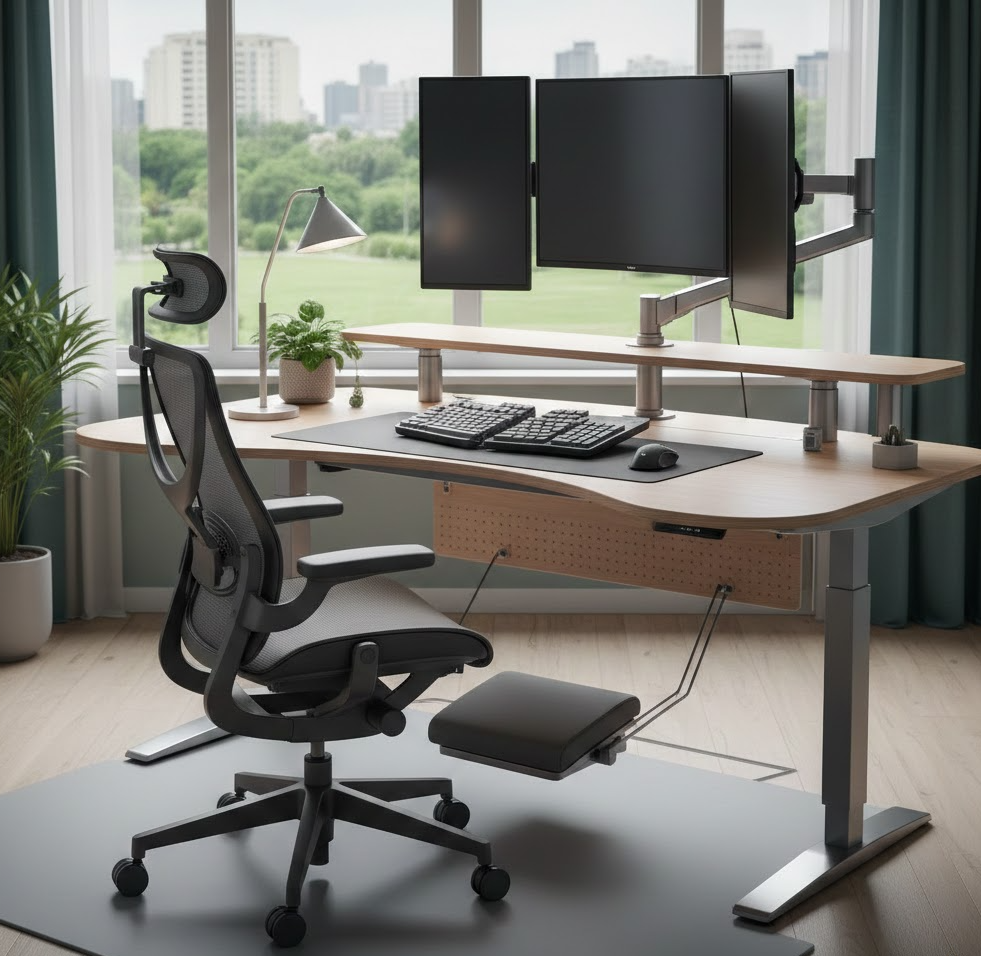
Selecting the right chair is a foundational step in creating a workspace that supports good posture and minimizes the risk of back pain. An ergonomic chair with proper lumbar support helps maintain the natural curve of the lower back, reducing strain on the back muscles during prolonged sitting. Adjustable features—such as seat height, armrests, and seat depth—allow you to tailor the chair to your body, ensuring that your feet can rest flat on the floor or on an ergonomic footrest for optimal support.
Material matters, too. Chairs with breathable mesh or high-quality fabric help keep you cool and comfortable, even during long work sessions. Durability and adjustability are key, as a well-constructed chair will provide consistent support and adapt to your needs over time. If your chair doesn’t include a built-in footrest, consider adding an ergonomic footrest to promote proper foot positioning and further reduce pressure on the lower back.
By investing in a chair that prioritizes lumbar support, adjustability, and comfort, you create a supportive foundation that encourages good posture, reduces muscle strain, and lowers the risk of pain and discomfort associated with sitting for prolonged periods.

The Importance of Regular Breaks
No matter how well your workspace is set up, taking regular breaks is essential for maintaining health and comfort during prolonged sitting. Sitting in the same position for too long can restrict blood flow, increase muscle strain, and contribute to a range of health problems, from back pain to fatigue. Incorporating movement into your daily routine is a simple yet powerful way to support overall posture and well-being.
Aim to stand up, stretch, and move around every 30 to 60 minutes. Even brief breaks—walking around the office, stretching your legs and arms, or simply standing—can help restore circulation, reduce muscle tension, and give your body a chance to reset. These moments of movement not only support spinal health and reduce the risk of discomfort, but also improve focus and productivity throughout the day.
By making regular breaks a non-negotiable part of your workday, you take a holistic approach to health and posture. This simple habit, combined with proper ergonomics and support, helps counteract the risks of prolonged sitting and keeps you feeling comfortable and energized, no matter how long your workday lasts.

Designing a Sitting Setup That Reduces Lumbar Pressure All Day
Creating a more comfortable sitting experience is less about memorizing posture rules and more about applying a few core principles consistently. Rules tend to focus on how you should look while sitting. Principles focus on how your body is supported over time.
When setting up your computer workstation, it is important to position your computer monitor so that the top of the screen is at or just below eye level to reduce neck and eye strain. Place your computer keyboard and keyboard so that your wrists and upper arms remain in a neutral position, with your upper arms close to your body and wrists aligned with your forearms. Using a wrist rest can help maintain neutral wrist positioning and prevent strain during prolonged typing. Additionally, always use proper lifting techniques when moving office equipment or adjusting your workstation to prevent lower back strain.
A pressure-reducing sitting setup begins with seat height that allows the pelvis to remain neutral, rather than encouraging it to roll backward or become unstable. From there, hip angles should be open enough to preserve the natural curve of the lower back without requiring muscular effort to maintain it. Just as importantly, foot positioning should feel grounded and stable, providing a reliable base that limits unnecessary pelvic movement throughout the day.
Support plays a crucial role in holding these relationships together. Without it, even well-adjusted setups tend to drift as cushions compress, muscles fatigue, and posture gradually changes. With appropriate support, these angles are preserved with less effort, allowing the body to settle instead of constantly compensating.
When seat height, hip angle, and foot support work together as a system, sitting becomes noticeably calmer and less demanding. The lower back no longer has to manage excess load, fatigue develops more slowly, and sitting tolerance improves naturally—making long workdays far easier to sustain.

Conclusion: When Angles Are Supported, Sitting Stops Feeling Like Work
Lower back pressure during desk work is not a personal shortcoming, nor is it a sign that your body is failing to adapt. It is a mechanical response to sitting in positions that lack adequate structural support.
Seat height determines how the pelvis is positioned on the chair. Hip angle influences whether the natural curve of the lower back is preserved or flattened. Foot positioning provides the stability that allows the pelvis and spine to remain settled over time. Each of these factors contributes directly to how pressure is distributed through the lumbar spine during prolonged sitting.
When these angles are unsupported, pressure gradually accumulates. Muscles work harder than intended, fatigue develops, and sitting becomes increasingly demanding as the day progresses. When the same angles are properly supported, load is shared more evenly, muscular effort decreases, and the body is able to relax into the chair rather than brace against it.
Stretching remains valuable for recovery. Movement is essential for resetting the body throughout the day. But for the hours spent seated, support is what makes endurance possible.
By maintaining the angles your body expects while sitting, desk work no longer feels like something to push through. Instead, it becomes calmer, more sustainable, and far closer to the way sitting was always meant to feel.