Lower Back Fatigue: Understanding Desk Work Impact
If your lower back doesn’t present as sharp or acute pain—but instead feels tired, heavy, or progressively worn down by the end of the workday—you are far from alone. Lower back fatigue from desk work is one of the most frequently reported forms of discomfort among people who spend long hours seated.
Despite how common it is, this type of fatigue is often misunderstood. It is frequently attributed to poor posture, weak core muscles, or awkward positions caused by improper desk setups. While those factors are often blamed, they are rarely the primary cause.
In most cases, lower back fatigue is not a personal shortcoming or a conditioning issue—it is a mechanical response to prolonged, unsupported sitting. When the body is placed under continuous low-level demand for hours at a time, fatigue is a predictable outcome.
In this article, we’ll examine:
-
What lower back fatigue actually is, and how it differs from pain or injury
-
How to distinguish lower back fatigue from back injury
-
Why sitting—despite appearing passive—still requires sustained muscular effort
-
Why maintaining “good posture” alone often fails to prevent fatigue
-
How targeted lumbar and seat support reduce constant strain during desk work and make sitting more sustainable
The goal is not to correct the body, but to understand the forces acting on it—and how proper support can change those forces over the course of a workday. Creating an ergonomic workspace is also essential for preventing lower back fatigue and promoting long-term comfort.
Why Your Lower Back Feels “Tired” at Your Desk
Lower back fatigue rarely announces itself as sharp or alarming pain. Instead, it tends to develop quietly and predictably over the course of the workday. Many people describe it as:
-
A dull, aching heaviness in the lower back
-
A sense of tightness or compression that deepens with time
-
Discomfort that builds gradually rather than appearing suddenly
-
Temporary relief when standing or walking, followed by a rapid return of fatigue once seated again
This pattern is distinct from injury-related back pain, which is often sharp, sudden, or persistent regardless of position. In fact, a large number of office workers experience lower back fatigue without any diagnosed back condition or structural problem.
That distinction matters.
When discomfort improves with movement and worsens with prolonged sitting, it suggests that the issue is not damage or weakness—but sustained demand. Fatigue, in this context, is not a warning sign of injury. It is a signal of prolonged workload.
Put simply, lower back fatigue is your body’s way of communicating:
“I’ve been supporting this position continuously for too long.”
Understanding this message is the first step toward addressing the real cause—not by pushing the body to work harder, but by reducing the constant effort it is being asked to maintain.

Lower Back Fatigue vs. Lower Back Pain
Lower back fatigue and lower back pain are often discussed as if they are the same problem—but they reflect very different processes in the body. Understanding the distinction is essential, because each requires a different approach.
Lower back fatigue is primarily the result of sustained muscular effort, while lower back pain is more commonly associated with tissue irritation, inflammation, or injury. Injury can involve structures such as spinal discs, which may become compressed or deteriorate due to prolonged sitting and poor ergonomic setups.
| Lower Back Fatigue |
Lower Back Pain |
|---|---|
| Caused by prolonged, low-level muscle activation | Often linked to irritation, strain, or injury |
| Develops gradually over hours | Can appear suddenly or acutely |
| Feels dull, heavy, or achy | Feels sharp, stabbing, burning, or intense |
| Improves with rest, movement, or support |
May persist regardless of position |
| Related to endurance and load | Related to tissue sensitivity or damage |
Lower back fatigue from sitting is typically an endurance problem, not a damage problem. The muscles of the lower back are doing exactly what they’re designed to do—support the spine—but they are being asked to perform that role continuously, with little opportunity to rest.
Over time, even healthy, strong muscles will fatigue under constant demand. This is why lower back fatigue can occur even in people who exercise regularly, stretch consistently, or maintain good posture awareness.
Desk work is particularly effective at creating this type of overload because it combines:
-
Prolonged static positioning
-
Minimal variation in muscular demand
-
Inadequate structural support for the spine
If lower back pain persists for more than a few weeks, it may indicate a more serious issue requiring medical attention.
When these factors are present, fatigue is not a sign of failure—it is a predictable physiological response. Recognizing this difference helps shift the focus away from “fixing” the body and toward reducing the conditions that cause unnecessary strain in the first place.

Why Sitting Quietly Still Requires Work from Your Lower Back
Sitting may appear passive, but from a biomechanical perspective, it is anything but. Maintaining an upright seated position places continuous demands on the structures of the lower back—even in the absence of movement.
When you sit upright at a desk:
-
Gravity pulls the weight of your upper body forward
-
The lumbar spine must preserve its natural inward curve
-
Small stabilizing muscles in the lower back remain active to prevent the spine from collapsing or slumping
The position of your computer screen can significantly influence your posture; if it is too high or too low, it can contribute to neck, back, and shoulder strain, ultimately increasing lower back fatigue.
As a result, your lower back muscles are constantly engaged, even when you feel as though you are “just sitting.” Adjusting your workspace so your elbows remain at a 90-degree angle and your hands and forearms can rest comfortably in a neutral position is essential for reducing strain and supporting ergonomic comfort.
Unlike activities such as walking or standing—where muscles alternate between contraction and relaxation—desk sitting creates what is known as static load. Under static load:
-
The same muscle fibers remain active for extended periods
-
Blood flow to those muscles is reduced
-
Waste products accumulate more quickly
-
Fatigue develops at a faster rate
This is why lower back discomfort during desk work often presents as gradual exhaustion rather than sharp pain. The muscles are not being overloaded in short bursts; they are being asked to sustain low-level effort without adequate relief.
It also explains why so many people search for answers using phrases like:
-
“Why does my lower back get tired when sitting?”
-
“Lower back muscles working while sitting”
-
“Static sitting back fatigue”
These questions reflect a common experience: the effects of prolonged, uninterrupted muscle activation. Over time, even modest levels of continuous effort lead to fatigue—particularly when sitting is repeated day after day without sufficient structural support.

Why “Good Posture” Can Still Lead to Lower Back Exhaustion
Many people respond to lower back fatigue by trying to sit up straighter, engage their core more deliberately, or constantly correct their posture throughout the day. Initially, this approach can feel beneficial. Sitting upright may create a sense of alignment or control, and discomfort may seem reduced—at least temporarily.
Over time, however, this strategy often leads to greater fatigue, not less.
The reason is simple: posture without adequate support depends on continuous muscular effort.
When you actively hold yourself upright:
-
The core and lower back muscles assume the role of structural support
-
Muscles compensate for the absence of external support from the chair
-
Sitting shifts from a resting position to a prolonged, low-intensity workout
In this scenario, posture becomes something you maintain rather than something your environment supports. The muscles responsible for stability remain engaged for hours, with little opportunity to relax.
To improve posture and reduce strain on the lower back, it is essential to focus on proper ergonomics and targeted interventions, such as using ergonomic chairs and adjusting your workspace to support natural alignment.
This is why many desk workers find themselves thinking:
“I have good posture—so why does my lower back still feel exhausted?”
The issue is not a lack of posture awareness or discipline. It is an unsupported posture. When alignment relies entirely on muscle activation, fatigue is inevitable.
Muscles are designed to facilitate movement, adapt to changing loads, and provide short-term stability when needed. They are not meant to function as furniture—holding the body upright for eight or more hours at a time.
True ergonomic sitting does not require constant correction. It reduces the amount of effort your body must expend to maintain alignment, allowing muscles to assist rather than compensate.

Why Your Lower Back Feels Better When You Stand or Walk
If your lower back fatigue eases when you stand up, walk around, or stretch briefly, that response is both common and expected. It is not coincidental—it reflects how the body responds to changes in load and movement.
Movement helps reduce fatigue because it introduces variation into a system that has been under sustained demand. When you stand or walk:
-
Load shifts across different joints and tissues
-
Muscles that were working continuously are given brief recovery periods
-
Blood flow improves, helping clear metabolic byproducts associated with fatigue
Regular movement and breaks are important because they help prevent discomfort associated with prolonged sitting by reducing muscle stiffness and improving circulation.
Standing and walking reduce the static demands placed on the lower back by allowing muscles to cycle between activity and rest. This kind of load variation is essential for muscular endurance and comfort.
Sitting, in contrast, holds the lower back in a relatively fixed position. The same stabilizing muscles remain active for extended periods, which is why:
-
Short breaks feel immediately relieving
-
Relief fades quickly once sitting resumes
-
Fatigue tends to return within minutes of being seated again
This pattern often leads people to rely heavily on frequent breaks or stretching to manage discomfort. While these strategies are valuable, they primarily address recovery, not the underlying cause.
Movement helps your lower back recover from strain—but it does not change the conditions that create fatigue during the many hours spent seated. Without reducing the ongoing demand placed on the lower back while sitting, fatigue will continue to accumulate between breaks.

Why Stretching Helps—but Doesn’t Stop Daily Lower Back Fatigue
Stretching is frequently recommended for desk-related lower back discomfort, and for good reason—it does provide meaningful benefits. When used appropriately, stretching can:
-
Improve circulation to fatigued tissues
-
Reduce stiffness and the sensation of tightness
-
Support muscle recovery after prolonged strain
For many people, stretching brings noticeable short-term relief, particularly after long periods of sitting. However, while stretching can be helpful, it does not address the primary source of daily lower back fatigue. Incorporating regular physical activity, such as aerobic exercise, strength training, and stretching, is essential to support lower back health and prevent fatigue associated with desk work.
Lower back fatigue from desk work is not driven by chronically tight muscles. It is driven by continuous, low-level demand placed on the same muscles for hours at a time. Stretching may temporarily restore length or blood flow, but it does not reduce the workload those muscles face once sitting resumes.
Even a well-designed stretching routine cannot offset eight or more hours of unsupported sitting. You can stretch your lower back thoroughly in the morning, feel looser and more comfortable, and still experience significant fatigue by the afternoon if the underlying demands remain unchanged.
Put simply:
-
Stretching supports recovery
-
Structural support reduces ongoing strain
Both play important roles, but they serve different purposes. Stretching helps your body recover from the effort it has already expended. Support determines how much effort your body is required to expend in the first place.
When combined thoughtfully, movement and support work together to improve comfort. But when stretching is used alone, it often functions as a temporary reset rather than a lasting solution.

How Targeted Lumbar Support Reduces Constant Muscle Demand
This is where targeted lumbar support meaningfully changes how the lower back functions during desk work.
Effective lumbar support is not about forcing posture or holding the body in a rigid position. Its role is to restore structural support where modern seating often falls short. When properly designed and positioned, lumbar support:
-
Maintains the natural inward curve of the lower spine
-
Limits forward collapse of the torso
-
Transfers a portion of the load from muscles to external structure
When the lumbar spine is supported, the stabilizing muscles of the lower back no longer need to remain constantly engaged just to keep the body upright. Instead, they are able to operate in a more neutral, efficient state—supporting posture when needed rather than compensating for missing structure.
A contoured option like the Serenform Atlas Lumbar Pillow is designed with this specific goal in mind. Rather than encouraging active correction, it works by:
-
Filling the lumbar gap that most modern chairs leave unsupported
-
Preserving spinal alignment without requiring conscious effort
-
Reducing the continuous muscular demand that contributes to fatigue during desk work
In this context, support is not about discipline or posture enforcement. It is about reducing the baseline workload placed on the lower back throughout the day. By restoring structure, lumbar support allows muscles to relax, pressure to decrease, and sitting to become more sustainable over long periods.

Why Seat Support Matters for Lower Back Fatigue Too
Lower back fatigue is often discussed as a spinal issue, but in practice, it is just as much a pelvic stability issue. The position and support of the pelvis play a critical role in determining how much strain is placed on the lower back during sitting. Keeping your feet flat on the floor and wearing supportive shoes further enhances stability, promotes proper spinal alignment, and helps reduce lower back fatigue during desk work.
When a seat:
-
Is overly flat or lacks contour
-
Compresses significantly under body weight
-
Allows the pelvis to tilt backward
the lumbar spine loses its natural inward curve. As that curve flattens, the muscles of the lower back must work harder to maintain upright posture, increasing strain and accelerating fatigue.
Targeted seat support helps address this problem at its foundation. By improving how the body is supported at the hips, effective seat cushioning can:
-
Stabilize pelvic position
-
Distribute pressure more evenly across the sitting surface
-
Provide a more stable base for the spine above
The Serenform Summit Seat Cushion is designed to complement lumbar support by addressing alignment from the base upward. Its purpose is not simply to add softness, but to:
-
Improve sitting alignment starting at the pelvis
-
Reduce pressure points that encourage slouching or shifting
-
Help maintain spinal structure without requiring constant adjustment or effort
When seat support and lumbar support work together, the entire sitting system becomes more efficient. The pelvis is stabilized, the lumbar curve is preserved, and the lower back muscles are no longer forced to compensate for instability below them. Over the course of a workday, this combined support significantly reduces the cumulative workload placed on the lower back.

Workspace Setup: Creating a Back-Friendly Desk Environment
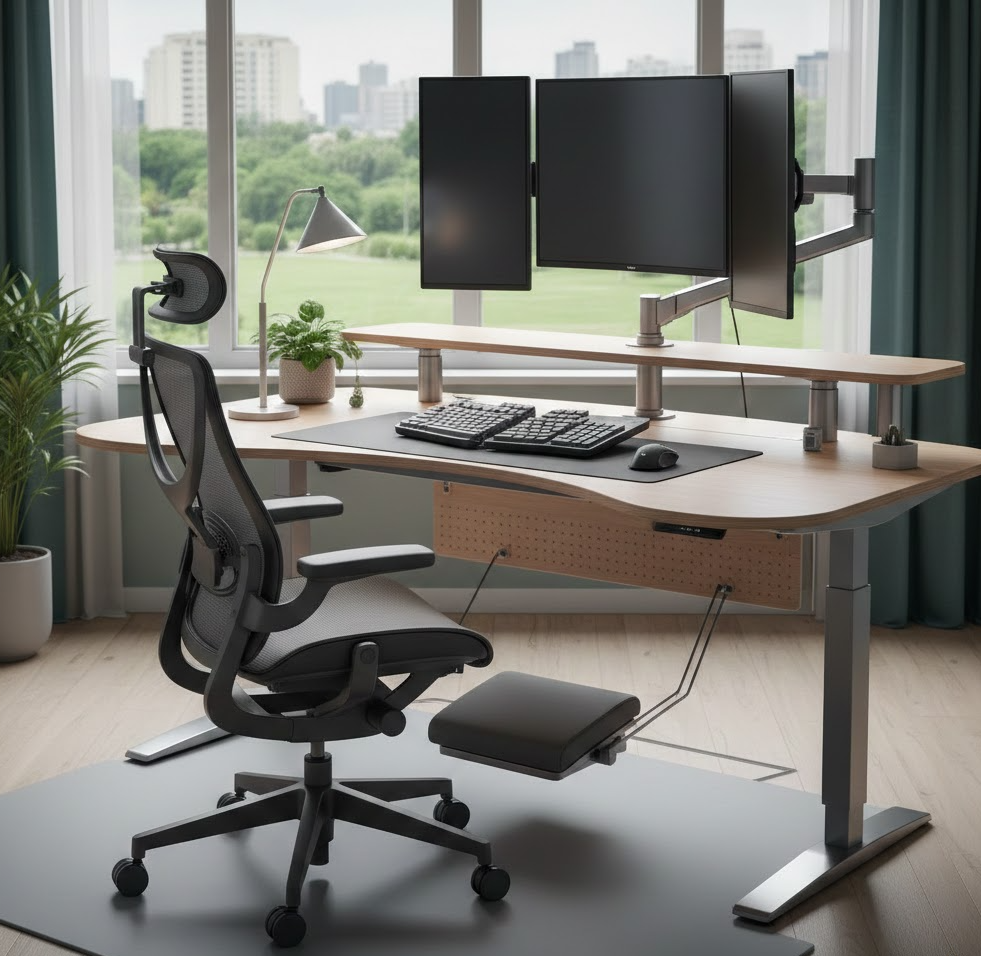
Setting up your workspace with your back in mind is one of the most effective ways to prevent lower back pain and maintain good posture throughout the day. Start by ensuring your feet are flat on the floor or supported by a footrest, with your knees bent at a comfortable 90-degree angle. This stable starting position helps keep your spine aligned and reduces unnecessary strain.
Choose a chair that offers proper lumbar support to maintain the natural curve of your lower back. The backrest should gently arch to support your lumbar spine, helping to prevent muscle spasms and fatigue. Position your desk at a height that allows your elbows to remain at your sides and your shoulders relaxed, so you don’t have to lean forward or hunch over.
Your computer monitor should be directly in front of you, about 20-30 inches away, with the top of the screen at or just below eye level. This setup helps prevent neck strain and repetitive strain on your upper back and shoulders. Keep your keyboard and mouse within easy reach to avoid overextending your arms or causing pain in your wrists and shoulder blades.
Remember to take frequent breaks—stand up, stretch, and move around every 30-60 minutes. These simple actions improve blood flow, relieve tension, and help prevent the tight muscles and discomfort that can result from long periods of sitting. By following ergonomic principles and making small adjustments to your desk setup, you can create a supportive environment that reduces the risk of back pain and helps you maintain good posture all day long.

Reducing Lower Back Fatigue Is About Supporting the Body During Sitting
Lower back fatigue from desk work is not an indication that you are weak, inflexible, or failing to sit “correctly.” It is a predictable physiological response to the conditions most modern work environments create.
Extended desk work typically combines:
-
Long hours of static sitting
-
Inadequate structural support from standard chairs
-
Muscles being asked to perform a stabilizing role they were never designed to sustain continuously
Under these circumstances, fatigue is not a flaw—it is an expected outcome. Even strong, well-conditioned muscles will tire when they are required to remain active without meaningful relief.
When proper structure is restored through effective support, the demands placed on the body change significantly. With adequate support in place:
-
Muscles are able to relax instead of compensating
-
Pressure on the spine and surrounding tissues decreases
-
Sitting tolerance improves gradually and naturally over time
Rather than relying solely on breaks, stretching, or constant posture correction, support alters what your body experiences for the majority of the workday. It reduces the baseline effort required to sit, allowing the lower back to function as intended instead of working overtime.
Addressing lower back fatigue is less about asking the body to do more—and more about giving it the support it needs to do less.

Treatment Options When Lower Back Fatigue Persists
If you continue to experience lower back fatigue despite maintaining proper posture and taking regular breaks, it’s important to consider additional treatment options. Consulting a physical therapist can be a crucial step in identifying the underlying causes of your discomfort and developing a targeted plan for pain relief.
A physical therapist will assess your posture, core muscles, and daily habits to create a personalized program that strengthens your abdominal and back muscles. They may recommend simple exercises, such as shoulder rolls and gentle stretches, to help loosen tight muscles and relieve tension. These easy exercises can be performed at your desk and are designed to keep your muscles engaged and flexible, reducing the risk of chronic pain.
In some cases, occupational health specialists may evaluate your workspace to ensure it supports good posture and minimizes strain. They can offer guidance on ergonomic improvements and help you create a supportive environment that promotes long-term well-being.
Early intervention is key to preventing more serious back problems. By working with healthcare professionals and incorporating their recommendations, you can achieve effective pain relief, prevent further injury, and maintain a healthy, active lifestyle—even if your job requires you to spend long hours at a desk.

Conclusion: When Your Lower Back Is Supported, Sitting Stops Feeling Like Work
Sitting should not feel like an activity you have to endure. When desk work consistently leaves your lower back feeling tired or depleted, the issue is rarely a lack of effort or discipline—it is a lack of support.
Lower back fatigue is the body’s way of signaling that it has been under continuous demand for too long. By understanding the mechanics behind desk-related fatigue, it becomes clear that lasting comfort does not come from holding posture more rigidly or pushing through discomfort. It comes from restoring the structural support the body expects while seated.
When support is properly addressed:
-
Muscular effort decreases
-
Pressure is redistributed more evenly
-
Sitting becomes calmer, lighter, and more sustainable over time
Stretching plays an important role in recovery. Movement helps reset the system. But it is targeted support that determines how much strain the body is exposed to throughout the workday.
When the lower back is supported, sitting no longer feels like work. It becomes a position the body can maintain comfortably—allowing you to focus on your tasks rather than on managing discomfort.