Understanding Chronic Desk Pain
Most chronic desk pain does not begin as pain in the conventional sense.
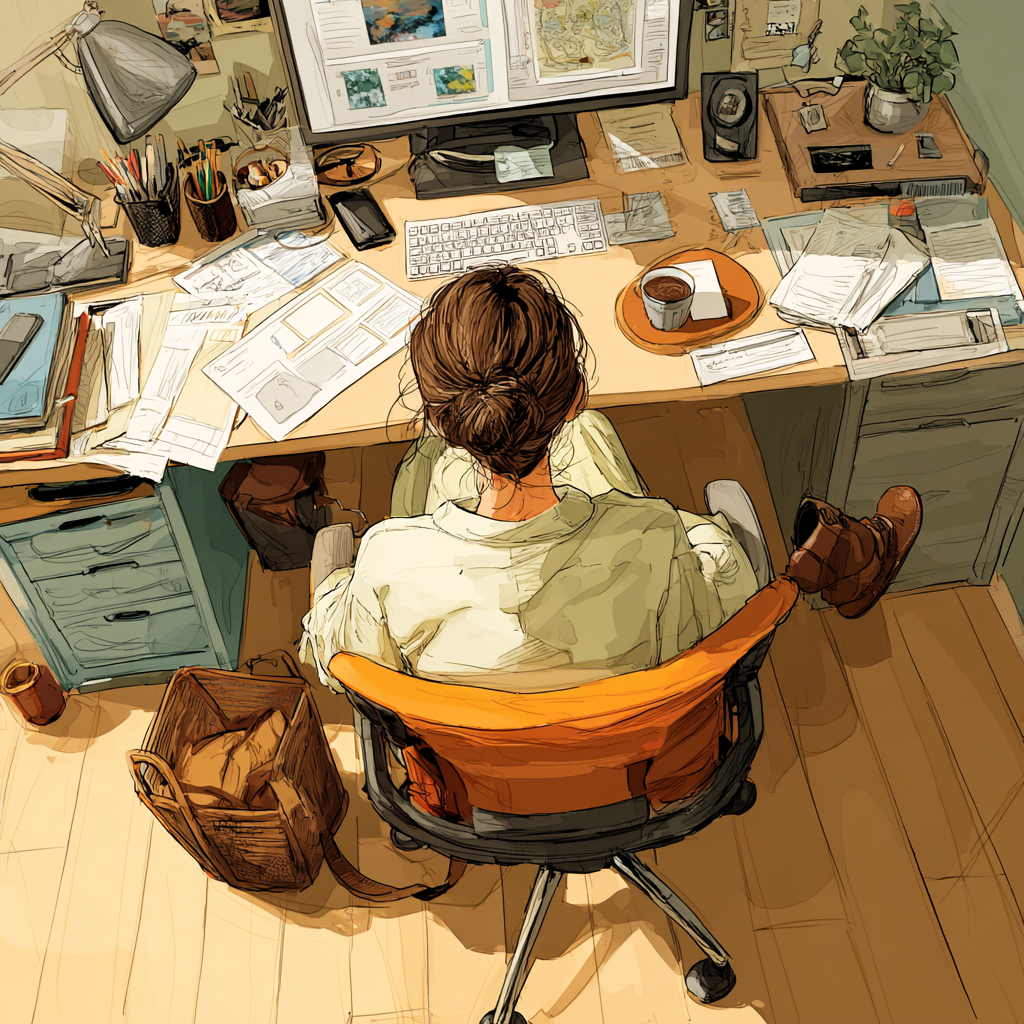
It often starts as subtle, easily dismissed signals—mild stiffness at the end of the workday, a low-grade ache that fades by morning, or a growing sense that sitting requires more effort than it once did. These sensations are rarely alarming. Because they are familiar and temporary, they are often accepted as a normal part of a desk job, which typically involves prolonged sitting and can contribute to chronic pain.
Over time, however, these small signals matter. Common causes of chronic desk pain include poor ergonomics, prolonged sitting, and bad posture, such as slouching or hunching over screens. These factors can lead to discomfort in the back and neck, legs, ankles, arms, and even the head, and may result in symptoms like shoulder pain or numbness that are often overlooked.
When low-level strain is repeated daily, the body does not simply “reset.” It adapts. And when a desk setup fails to support neutral posture, that adaptation occurs under continuous mechanical stress. Muscles remain engaged longer than intended, pressure is distributed unevenly, and the nervous system begins to treat strain as a constant background condition rather than a temporary demand. Poor posture can also put extra stress on spinal discs, increasing the risk of persistent pain
This is how temporary discomfort becomes persistent.
Chronic desk pain does not appear suddenly, nor is it typically the result of a single poor day or isolated movement. It develops gradually, through cumulative exposure to unsupported sitting positions that the body is forced to manage hour after hour. Patients with desk jobs may also face increased risks of heart disease due to prolonged sitting, but incorporating exercise and movement—even during phone calls—can help reduce discomfort and long-term health risks. Maintaining proper alignment of the head and neck is also important for preventing pain, and using focus techniques can help manage discomfort mentally.
This article explains how daily, low-level strain from unsupported sitting quietly progresses into chronic pain—and why addressing structural support is often more effective than relying solely on posture correction or increased stretching.

Chronic Pain Doesn’t Start as Pain
One of the most common misconceptions about chronic desk-related pain is the belief that it begins with an injury, a sudden flare-up, or a clearly identifiable moment when something “went wrong.”
In reality, chronic pain most often develops without a single defining event.
It typically begins with subtle, non-threatening signals:
-
Mild discomfort while sitting
-
Low-level muscular fatigue
-
A frequent need to shift, stretch, or change positions
These sensations rarely feel serious. They don’t interrupt productivity, and they often resolve temporarily with rest or movement. As a result, they are easy to dismiss—or normalize—as part of everyday desk work.
However, these early signals are meaningful.
The human body continuously adapts to the conditions it experiences most often. When daily sitting involves even small amounts of unsupported strain, the muscles and nervous system begin to adjust around that load. Stabilizing muscles remain active longer than intended, and the nervous system learns to maintain a heightened level of tension in order to protect against collapse or imbalance.
This process is not dramatic or dangerous.
It is quiet and consistent.
Over time, the body stops fully relaxing in those seated positions. What once felt like mild effort begins to feel uncomfortable sooner, and discomfort becomes easier to provoke with less sitting time. Eventually, the line between “fatigue” and “pain” begins to blur.
This is how chronic desk pain develops—not through a single incident, but through gradual adaptation to repeated, low-level strain.

Why Daily Desk Discomfort Doesn’t Fully Go Away
When desk-related discomfort fades overnight or improves over the weekend, it is easy to assume the problem is resolving. But if the same discomfort returns each workday—often within the first few hours of sitting—the issue is not a lack of recovery.
It is a load problem.
Rest plays an important role in short-term relief. Sleep allows tissues to recover, inflammation to settle, and muscles to relax. Time away from the desk reduces immediate demand. However, recovery alone cannot offset a daily mechanical load that remains unchanged.
Each morning, when you return to the same unsupported sitting position, the same forces are placed on the body again. The spine settles into the same angles, the same muscles resume stabilizing work, and pressure is distributed in the same inefficient way. From the body’s perspective, the cycle simply restarts.
This pattern explains why many desk workers experience:
-
Discomfort that resolves overnight but reappears shortly after sitting
-
Pain that becomes noticeable earlier in the day over time
-
A persistent sense of “starting over,” despite regular rest
In this situation, the body never has an opportunity to get ahead of the strain. It remains in a reactive state—responding to load rather than adapting away from it.
This ongoing exposure is one of the earliest pathways by which desk discomfort becomes chronic. Not through worsening injury or structural damage, but through the repeated return of the same unsupported demands, day after day.

The Quiet Accumulation of Low-Level Strain
Chronic pain does not require extreme stress, heavy exertion, or obvious trauma to develop. More often, it develops through repetition.
In desk-based work, strain is usually subtle. Slight lumbar rounding, hips that are not adequately supported, or feet that lack stable contact with the floor rarely cause immediate or sharp pain. Instead, these small misalignments create a continuous, low-level mechanical load that the body is required to manage throughout the day.
Unlike acute strain, this type of load is easy to overlook. It does not demand attention. Yet it accumulates.
Over the course of a workday, that background strain:
-
Builds gradually, hour by hour
-
Repeats in nearly identical patterns each day
-
Conditions tissues and muscles to operate under constant demand
Rather than increasing tolerance, this repeated exposure often has the opposite effect. Muscles fatigue sooner, joints become more sensitive, and the body becomes less efficient at relaxing in those seated positions.
Because the strain is mild and familiar, the nervous system does not register it as a problem that requires immediate correction. There is no clear warning signal, no obvious point at which sitting must stop. As a result, the exposure continues long enough for the body to adapt to the strain itself rather than recover from it.
This is how desk work can lead to chronic pain without any single injury or dramatic event—through the quiet accumulation of low-level strain that the body experiences, manages, and eventually internalizes.

When Muscles Compensate for Missing Support
The muscles that stabilize your spine and hips are designed to assist movement, not to hold your body in a fixed position for hours at a time. During prolonged sitting, they are meant to provide light, intermittent support—while the structure of the chair and workstation carries most of the load.
When a sitting setup lacks proper support, that balance shifts.
In the absence of adequate seat, lumbar, or foot support, muscles are forced to compensate for what the furniture does not provide. They take on a structural role, acting as substitutes for stability and alignment that should be maintained passively. This compensation often occurs without conscious effort, making it difficult to recognize until fatigue sets in.
Common patterns of muscular compensation during unsupported sitting include:
-
Core muscles remaining continuously engaged to prevent collapse
-
Hip flexors staying shortened and tense to stabilize pelvic position
-
Lower back muscles maintaining constant low-grade contraction
Initially, this compensation presents as generalized fatigue—a sense that sitting simply feels demanding. Over time, as muscles are asked to perform this stabilizing role day after day, fatigue gives way to sensitivity. Muscles become less tolerant of load, and discomfort begins to appear sooner and with less provocation.
This progression is not a sign of weakness or poor conditioning.
It is a predictable result of overuse.
When muscles are never given the opportunity to fully relax during the workday, the nervous system remains in a state of heightened readiness. Protective tension becomes the default, and the threshold for pain lowers accordingly. As a result, even short periods of sitting can begin to trigger discomfort.

Why Stretching and Movement Can’t Cancel Daily Sitting Strain
Stretching plays an important role in maintaining mobility.
Movement supports circulation, tissue health, and short-term relief.
But neither can fully counteract what your body is exposed to for most of the workday.
Stretching helps muscles recover from tension, and movement provides a temporary break from static positions. These strategies are valuable. However, they do not change the mechanical demands placed on the body when you return to sitting. If that seated position remains unsupported, the same forces and patterns of strain resume almost immediately.
This often leads to a familiar cycle:
-
Temporary relief following movement or stretching
-
Discomfort returning shortly after sitting again
-
Increasing dependence on recovery strategies to manage symptoms
In this cycle, recovery is repeatedly asked to compensate for ongoing exposure. While it can help the body reset momentarily, it cannot reduce the cumulative load created by unsupported sitting.
Recovery helps you reset.
Support helps you endure.
Without addressing the mechanical requirements of sitting itself—how the pelvis is supported, how the spine is stabilized, and how weight is distributed—stretching alone cannot prevent low-level strain from accumulating. Over time, that accumulation is what allows desk-related discomfort to become chronic.

How Repeated Strain Trains the Nervous System
When low-level strain is repeated day after day, the nervous system does not remain neutral. It adapts to the conditions it encounters most often.
Areas of the body that are consistently exposed to mechanical stress—such as the lower back, hips, and surrounding stabilizing muscles—begin to change how they respond to load. Over time, these regions may:
-
Become more sensitive to pressure or prolonged positioning
-
Trigger discomfort more quickly than they once did
-
Maintain a subtle level of muscular guarding even during rest
This process does not indicate that damage is occurring. Rather, it reflects the body’s attempt to protect itself. The nervous system becomes more vigilant in regions it perceives as under constant demand, adjusting pain thresholds and muscle tone to limit further strain.
In this context, chronic pain is not a signal of injury or structural failure. It is a signal of adaptation to ongoing load. The body is responding appropriately to repeated exposure by increasing sensitivity and maintaining readiness.
When the mechanical load is reduced—through improved support and more efficient distribution of pressure—the nervous system can begin to settle. Muscles relax more fully, sensitivity decreases, and comfort improves. When the load remains unchanged, however, this heightened sensitivity tends to persist.

Early Warning Signs Desk Pain Is Becoming Chronic
Chronic desk-related pain rarely announces itself with intensity. More often, it develops quietly, through small changes in how your body responds to sitting over time.
These early warning signs are easy to overlook because they do not always feel like “pain” in the traditional sense. Instead, they often show up as subtle shifts in tolerance and comfort.
Common indicators include:
-
A noticeable reduction in how long you can sit comfortably
-
Discomfort appearing earlier in the workday than it used to
-
A frequent need to shift positions, stand, or adjust your seat
-
General fatigue replacing sharp or localized pain
Taken together, these signals suggest that the body is compensating more during sitting and recovering less between workdays. Muscles remain engaged for longer periods, sensitivity increases, and the margin for comfortable sitting gradually narrows.
Recognizing these signs early matters. The sooner daily sitting strain is reduced—by improving how the body is supported—the easier it is to interrupt this progression. Addressing support at this stage often prevents mild, manageable discomfort from evolving into persistent pain.

Office Ergonomics: The Foundation of Desk Health
Office ergonomics is the cornerstone of preventing chronic pain conditions that often arise from desk jobs. When your workspace isn’t set up to support your body, prolonged sitting can quickly lead to poor posture, putting extra stress on your spine, shoulders, and hips. Over time, this can result in persistent neck pain, joint pain, and back pain—some of the most common pain conditions among office workers.
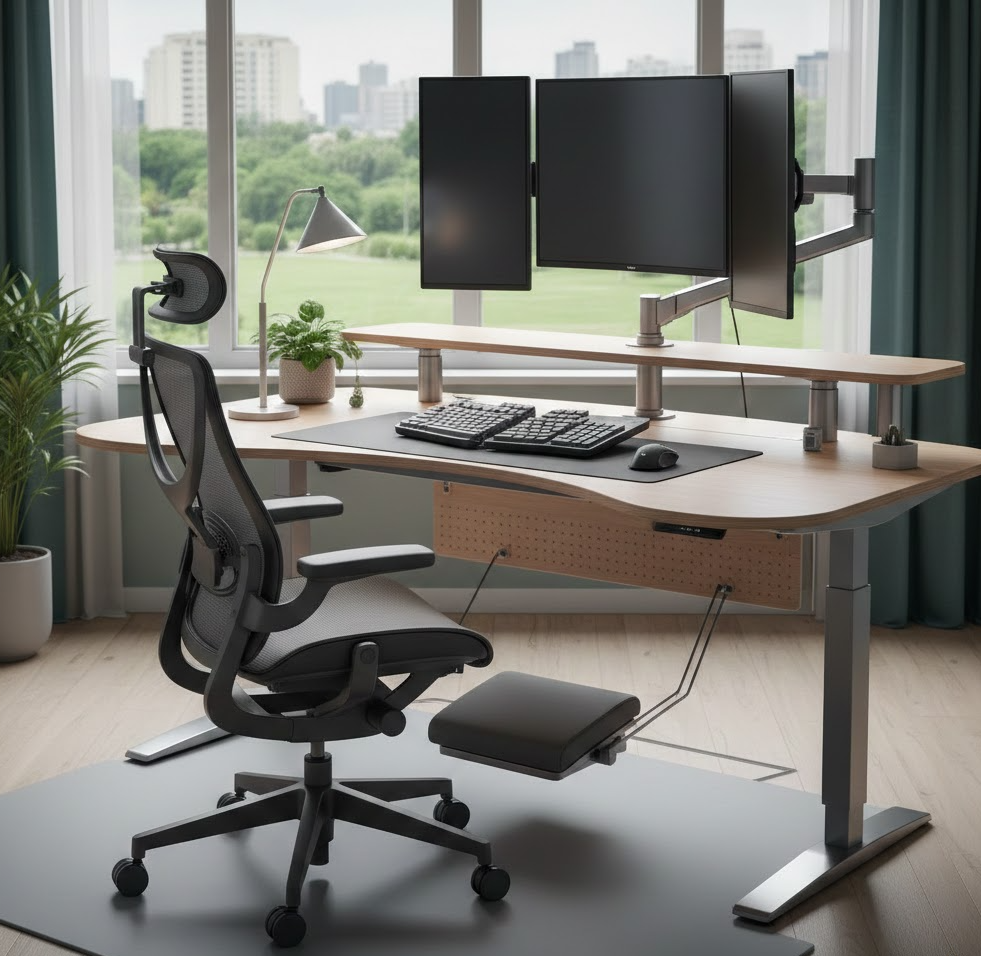
A well-designed ergonomic setup can make a significant difference. Start with a chair that offers proper lumbar support to maintain the natural curve of your spine. Adjust your chair height so your feet rest flat on the floor and your knees are at a comfortable angle. Using a separate keyboard and mouse allows your shoulders and wrists to stay relaxed, reducing unnecessary strain.
But ergonomics isn’t just about furniture. Incorporating regular movement breaks throughout your day helps relieve tension and improve mobility, counteracting the effects of sitting for long periods. Even simple stretches or a short walk can reduce discomfort and support better posture. According to Harvard Health Publishing, adding physical activity to your daily routine not only helps reduce the risk of chronic pain but also improves overall health and well-being.
By prioritizing office ergonomics and making small adjustments to your workspace, you can reduce extra stress on your body, minimize discomfort, and create a healthier environment that supports you throughout your workday.

Creating a Healthy Workspace for Lasting Comfort
Designing a healthy workspace is essential for lasting comfort and for reducing your risk of developing chronic pain. One of the most effective ways to support your body is by using a standing desk, which allows you to alternate between sitting and standing throughout the day. This simple change can help prevent stiffness and promote better blood flow, both of which are key to avoiding pain conditions linked to prolonged sitting.
An ergonomic chair with adjustable armrests and proper support for your back and hips is another important investment. Position your monitor at eye level to keep your neck and shoulders in a neutral position, reducing strain on your muscles and spine. Remember, your workspace should encourage you to stand, stretch, and move regularly—these movement breaks are crucial for relieving stiffness and maintaining healthy posture.
Incorporating exercises that strengthen your core muscles, especially the gluteus medius, can further protect you from chronic pain conditions like dead butt syndrome. Strong core muscles help stabilize your body, support better posture, and reduce the risk of discomfort during long hours at your desk.
By making these adjustments and prioritizing comfort, you not only reduce your risk of chronic pain but also improve your overall quality of life. A healthy workspace supports your body, keeps you moving, and helps you stay pain-free for the long term.

Preventing Chronic Desk Pain Starts With Daily Support
The most effective way to prevent desk-related discomfort from becoming chronic is not by forcing better posture or adding more breaks to an already full workday. It begins by reducing the mechanical strain the body experiences while sitting.
This is where targeted ergonomic support becomes essential.
When a seating setup properly supports neutral posture, the body no longer has to work continuously to maintain alignment. Instead of relying on constant muscular effort, structure does the work. As a result:
-
Muscles are able to relax rather than brace
-
Pressure is distributed more evenly across the pelvis and spine
-
Sitting feels more passive and sustainable, rather than effortful
Support does not attempt to “correct” posture through cues or reminders. It maintains the conditions that allow neutral posture to occur naturally and consistently.
Solutions such as the Serenform Sit Well Bundle are designed to support both seat and lumbar alignment together, addressing two of the most common sources of daily sitting strain. By stabilizing pelvic position and maintaining spinal support simultaneously, the body experiences less cumulative load throughout the day.
For individuals with longer work hours or more demanding desk routines, the Home Office Complete Bundle extends this approach by integrating lumbar, seat, and posture support into a unified system. This reduces strain across the entire sitting experience, rather than addressing individual discomfort in isolation.
Support does not ask your body to work harder.
It carries the load so your body does not have to.

When to Seek Professional Help for Desk Pain
If you find that desk pain is persistent or interfering with your daily life, it’s time to seek professional help from a physical therapist. Chronic pain—whether it’s neck pain, joint pain, or low back pain—can be a major cause of discomfort and may signal underlying issues such as poor posture, weak muscles, or joint misalignment.
A physical therapist can assess your posture, identify weak muscles, and develop a personalized treatment plan to address your specific pain conditions. This plan may include targeted exercises and stretches to improve mobility, reduce pain, and prevent further injury. For those with chronic pain conditions like rheumatoid arthritis, a comprehensive approach that combines medication, physical therapy, and lifestyle changes may be necessary.
Early intervention is key. Regular check-ins with a physical therapist can help you stay ahead of discomfort, prevent long-term damage, and reduce your risk of developing chronic pain conditions. By addressing pain early and following a tailored treatment plan, you can improve your health, restore comfort at your desk, and enhance your overall quality of life.

Conclusion: Chronic Desk Pain Is Built—But It Can Be Interrupted
Chronic desk-related pain is not a personal shortcoming, nor is it a sudden or mysterious condition. In most cases, it develops gradually, through daily exposure to low-level strain that the body is asked to manage without adequate support.
This progression is neither dramatic nor inevitable. It is mechanical.
When sitting requires constant muscular effort, compensation becomes routine. Over time, that routine shapes how the body responds to desk work, narrowing the margin for comfort and allowing discomfort to persist more easily. What begins as mild fatigue can slowly evolve into chronic pain when the underlying strain remains unchanged.
Stretching plays an important role in recovery.
Movement helps restore circulation and reset the body.
But lasting comfort depends on reducing the demands placed on the body throughout the workday.
When a sitting setup consistently supports neutral posture, the need for compensation decreases. Muscles can relax more fully, pressure is distributed more efficiently, and the nervous system is able to settle. In the absence of ongoing strain, chronic pain loses the conditions it needs to persist.
Change the daily input, and the outcome changes with it.