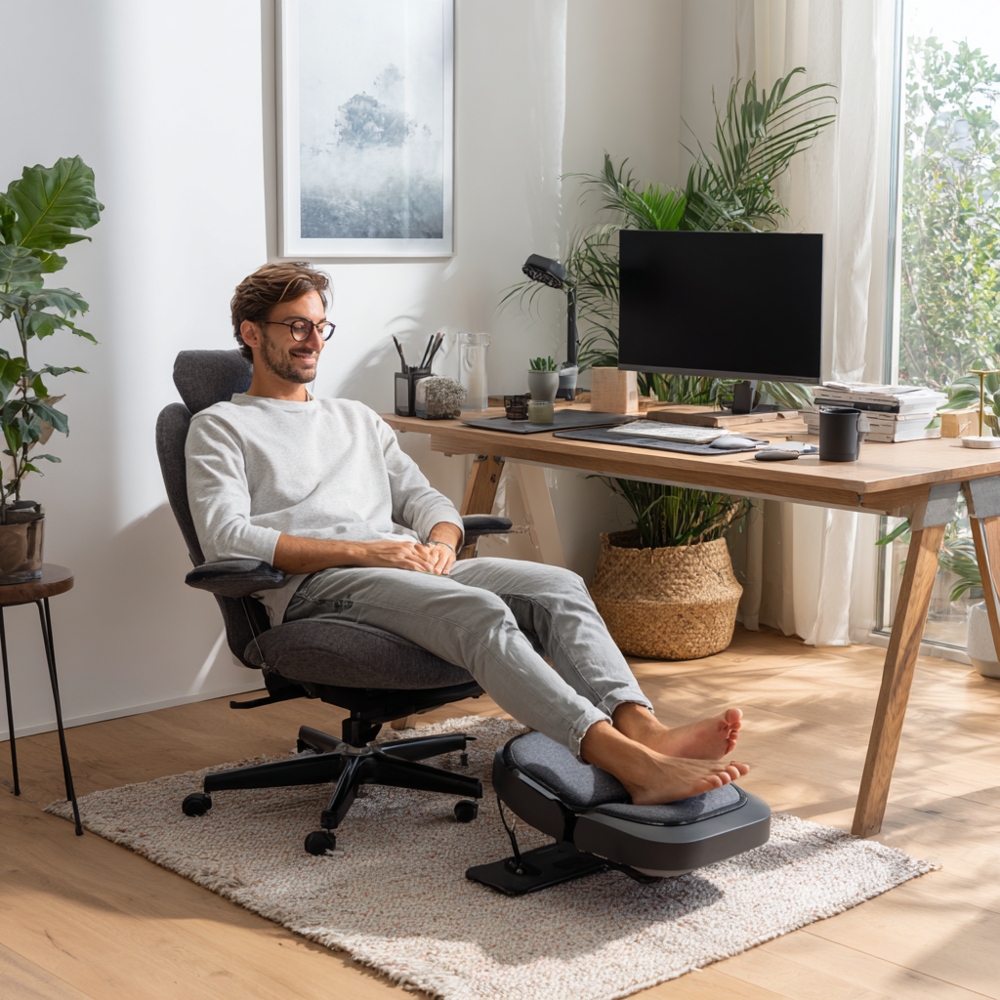
Ergonomic Footrest Benefits: Do You Really Need One?
Introduction: Why Foot Support Matters More Than You Think
In any workspace—whether a corporate office, a home setup, or a hybrid environment—comfort and posture depend on more than just your chair or desk height. One of the most overlooked yet critical factors is how your feet are supported throughout the day.
Footrests are often dismissed as optional accessories. In reality, they play a foundational role in how your body sits, moves, and performs. Your feet anchor your entire seated posture. When they’re unsupported, the effects don’t stay isolated—they travel upward through the legs, hips, pelvis, and spine.
Without proper foot support:
- The pelvis tilts backward
- The lumbar spine loses stability
- Circulation in the lower limbs becomes restricted
Over time, these subtle shifts lead to poor posture, muscle fatigue, reduced focus, and persistent discomfort. What begins as minor strain can gradually develop into chronic back tension and long-term musculoskeletal issues.
The difference is simple—but significant:
When your feet are supported, your entire body works more efficiently.
In this guide, you’ll learn how foot support directly impacts posture, circulation, and daily comfort. We’ll break down the real difference between sitting with and without a footrest, identify who benefits most, and explain when a footrest becomes essential—not optional.
You’ll also discover how a precision-designed solution like the Serenform Axis Footrest provides the stability, alignment, and support needed to transform any workspace into a more comfortable, performance-driven environment.

What Happens When Your Feet Aren’t Supported? (The Hidden Ergonomic Problem)
Discomfort from sitting rarely appears all at once.
It builds gradually.
A slight numbness in your legs.
A tingling sensation in your feet.
A dull tightness in your lower back that shows up earlier each day.
Most people assume these issues come from their chair or posture.
But in many cases, the problem starts much lower:
Your feet aren’t properly supported.
When your feet don’t rest firmly on a stable surface, your body begins to compensate automatically.
These adjustments may feel minor in the moment—but over time, they affect circulation, alignment, and overall comfort.
1. Increased Pressure on the Thighs
When your feet dangle or barely touch the floor, the weight of your legs shifts upward into the seat.
This creates excess pressure under the thighs—right where major blood vessels pass through.
As a result:
- Circulation becomes restricted
- Your legs may feel heavy or numb
- “Pins and needles” sensations become more frequent
2. Pelvic Tilt and Spinal Misalignment
Your feet act as the foundation of your seated posture.
Without that support, your pelvis begins to tilt backward.
This leads to:
- Loss of the natural curve in your lower back
- Increased strain on spinal discs
- Greater tension in the lower back muscles
Over time, this misalignment makes sitting feel more fatiguing—and less stable.
3. Reduced Circulation in the Legs
Proper foot contact allows for subtle movement in the ankles and calves, which helps maintain healthy blood flow.
When your feet are unsupported:
- Movement decreases
- Pressure increases
- Circulation slows
This can lead to:
- Swelling in the lower legs
- Fluid buildup (edema)
- Persistent leg fatigue during long sitting sessions
Why This Matters
These effects don’t happen suddenly.
They build quietly—day after day—until discomfort becomes your normal.
Research shows that unsupported or dangling feet and excessive pressure under the thighs can restrict circulation and contribute to long-term discomfort.
The key takeaway:
If your feet aren’t supported, your entire sitting position becomes less stable.
And when your foundation is unstable,
everything above it—your hips, spine, and posture—has to compensate.
That’s why proper foot support isn’t a minor adjustment.
It’s a foundational requirement for comfortable, sustainable sitting.

Footrest vs. No Footrest: A Clear Comparison
The easiest way to understand the value of a footrest is to compare how your body functions with—and without—proper foot support.
When your feet are supported, your body stays aligned, balanced, and more efficient.
When they’re not, your body compensates—and that’s where discomfort begins.
Side-by-Side Comparison
| Category | With Footrest | Without Footrest |
|---|---|---|
| Posture Alignment | Maintains a neutral spine with stable pelvic positioning | Pelvis tilts backward, flattening the lumbar curve and stressing the spine |
| Circulation | Promotes healthy blood flow with proper hip and knee angles | Circulation becomes restricted, leading to numbness, swelling, and fatigue |
| Lower-Back Pressure | Reduces strain by distributing weight evenly | Lower back absorbs excess load, increasing tension over time |
| Comfort Over Time | Encourages natural movement, reducing stiffness | Static posture leads to muscle fatigue and discomfort |
| Productivity | Sustained comfort supports focus and efficiency | Discomfort disrupts concentration and reduces work performance |
Why This Difference Matters
This isn’t a small adjustment—it’s a structural one.
When your feet are unsupported, your body is constantly working to compensate.
When they’re supported, your body can settle into a more stable, efficient position.
That difference shows up in how you feel throughout the day:
- Less strain on your lower back
- Better circulation in your legs
- More consistent comfort during long work sessions
A footrest isn’t just about comfort.
It’s about creating a stable foundation that allows everything above it to function properly.
Because when your foundation is supported,
your posture, comfort, and focus all improve together.

Types of Footrests: Choosing What Actually Works
Not all footrests provide the same level of support.
The right choice depends on how you sit, how long you sit, and whether your setup allows for movement throughout the day.
Fixed Footrests (Basic Support)
Fixed-height footrests provide a stable platform for your feet.
They’re simple and effective—but limited.
Best for:
- Static setups
- Minimal adjustment needs
Limitations:
- No flexibility for different body types
- No movement support
Adjustable Footrests (Custom Fit)
Adjustable footrests allow you to fine-tune height and angle to match your desk and chair.
Best for:
- Shared workspaces
- Users needing precise positioning
Limitations:
- Still largely static
- Limited support for movement
Dynamic / Rocking Footrests (Best for Long Sitting)
Dynamic footrests allow gentle rocking or movement while seated.
This is where ergonomic performance improves significantly.
They help:
-
Keep your legs active
-
Improve circulation
-
Reduce stiffness over time
-
Maintain comfort during long sessions
For extended desk work, dynamic footrests provide the most complete support—because they don’t just support your feet, they keep your body engaged.
How a Footrest Improves Circulation (Simple Explanation)
Sitting for long periods slows circulation—especially in the lower body.
That’s when you start to feel:
- Heaviness in your legs
- Numbness or tingling
- Fatigue that builds over time
A footrest helps solve this by improving how your body is positioned—and how it moves.
1. Better Blood Flow Through Proper Positioning
When your feet are supported:
- Your knees and hips stay at healthier angles
- Pressure behind the thighs is reduced
- Blood flows more freely through the legs
This helps prevent the buildup of pressure that leads to discomfort and swelling.
2. Natural Micro-Movements Keep Blood Moving
A stable surface under your feet allows for subtle movement throughout the day.
These small movements:
- Activate the calf muscles
- Improve circulation naturally
- Reduce stiffness from staying still too long
3. Dynamic Movement Enhances Circulation Further
With a dynamic or rocking footrest:
- Your ankles move gently
- Your calves stay engaged
- Blood flow is continuously supported
This activates what’s known as the “calf muscle pump”—a key mechanism for maintaining circulation during long sitting sessions.
Why This Matters
Circulation isn’t just about comfort.
It directly affects:
- Energy levels
- Focus
- Long-term leg and joint health
Research shows that dynamic footrests can improve lower-limb circulation and reduce discomfort during extended sitting.
The Key Takeaway
Not all footrests are equal.
Static support is helpful—but incomplete.
The best footrests combine support with movement.
That’s what allows your body to stay:
- Aligned
- Active
- Comfortable for longer periods

Active Sitting: Why Movement Matters While You Work
Sitting isn’t the problem.
Staying still for too long is.
Even in a well-designed setup, the body isn’t meant to remain static for hours.
That’s where active sitting comes in.
Active sitting introduces small, natural movements throughout the day—helping your body stay engaged instead of locked in one position.
How a Footrest Supports Active Sitting
A footrest—especially a dynamic or rocking design—makes movement effortless.
Instead of forcing yourself to adjust, your body naturally shifts position.
This helps:
- Keep your legs active
- Improve circulation
- Reduce pressure buildup
- Prevent stiffness during long sessions
These small movements may seem minor—but over time, they make a significant difference in comfort and endurance.
Because the goal isn’t to sit perfectly still.
It’s to sit in a way your body can sustain.
Lower Back Relief: How Foot Support Fixes Posture at the Source
Lower-back discomfort often feels like a back problem.
But in many cases, it starts with your foundation—your feet.
When your feet aren’t properly supported, your entire posture begins to shift.
What Happens Without Foot Support
- The pelvis rolls backward
- The natural curve of the lower back flattens
- Pressure increases on the spine
This creates a pattern of:
- Lower-back tightness
- Muscle fatigue
- Gradual discomfort during long sitting sessions
How a Footrest Reduces Back Strain
A properly designed footrest corrects this at the source.
It helps:
- Stabilize the pelvis → prevents backward tilt
- Restore spinal alignment → supports natural posture
- Reduce pressure on discs and muscles → minimizes strain
When your feet are grounded, your body no longer has to compensate.
Posture becomes easier to maintain—and sitting feels more stable.
Why This Matters
Lower-back discomfort doesn’t usually come from one big issue.
It builds from small misalignments repeated throughout the day.
Research and ergonomic guidelines consistently show that proper foot positioning—either flat on the floor or supported by a footrest—is essential for maintaining pelvic stability and reducing spinal strain.
The Key Takeaway
If your feet aren’t supported, your posture is constantly working against you.
If they are:
- Your spine stays aligned
- Your muscles work less
- Your comfort lasts longer
Because better posture doesn’t start with your back—
it starts with your foundation.

Who Actually Needs a Footrest?
While a footrest can improve comfort for anyone who sits for long periods, some people benefit from it immediately.
In these cases, a footrest isn’t optional—it’s essential for maintaining proper posture and reducing daily strain.
1. If Your Feet Don’t Fully Reach the Floor
If your feet don’t rest flat on the ground—or you have to raise your chair to match desk height—you’re likely sitting without proper support.
This leads to:
- Increased pressure under the thighs
- Pelvic instability
- Lower-back strain over time
A footrest restores a stable base, allowing your body to sit in proper alignment.
2. If You Work From Home or Use Non-Ergonomic Furniture
Most home setups weren’t designed for long hours of sitting.
Dining chairs, couches, and improvised desks often leave your feet unsupported.
This results in:
- Poor posture
- Faster fatigue
- Inconsistent sitting positions
A footrest creates a consistent ergonomic foundation—regardless of your setup.
3. If You Experience Leg Fatigue, Numbness, or Poor Circulation
If your legs feel heavy, numb, or swollen after sitting, your circulation may be restricted.
A footrest helps:
- Reduce pressure under the thighs
- Improve blood flow
- Prevent buildup of tension in the lower legs
4. If You Have Lower-Back or Hip Discomfort
Back pain doesn’t always start in the back.
It often begins with poor lower-body support.
When your feet aren’t stable:
- The pelvis shifts out of position
- The spine loses alignment
- Pressure increases on the lower back
A footrest helps restore that foundation—reducing strain at the source.
5. If You Sit for Long Hours Every Day
Even with a good chair, long sitting sessions create fatigue.
Without proper foot support, that fatigue builds faster.
A footrest helps:
- Maintain consistent posture
- Reduce muscle effort
- Improve comfort throughout the day
The Bottom Line
If any of these apply to you, a footrest isn’t just helpful—it’s necessary.
Because when your feet aren’t supported, your body is constantly compensating.
When they are, everything becomes easier:
- Better posture
- Less strain
- More sustainable comfort
And it all starts from the ground up.

How to Set Up Your Footrest for Maximum Benefit
A footrest only works if it’s positioned correctly.
Small adjustments in setup can make a noticeable difference in how well it supports your posture, circulation, and overall comfort.
1. Adjust the Height to Match Your Sitting Position
Your feet should rest fully supported, with:
- Knees at a natural angle (roughly level with or slightly below your hips)
- Thighs relaxed—not compressed against the seat
This helps stabilize your pelvis and maintain proper spinal alignment.
2. Keep Your Feet Fully Supported
Your entire foot—not just your heels—should rest comfortably on the surface.
This allows:
- Even weight distribution
- Better circulation
- More natural movement throughout the day
3. Ensure Stability
Your footrest should stay firmly in place while you use it.
A stable base:
- Prevents constant repositioning
- Maintains consistent posture
- Allows your body to relax into position
4. Allow for Natural Movement
If your footrest supports slight movement (such as rocking), use it.
Small, natural shifts:
- Improve circulation
- Reduce stiffness
- Help prevent fatigue during long sitting sessions
Keep Your Support Consistent Over Time
A footrest is a daily-use ergonomic tool—so maintaining it matters.
Keep It Clean and Functional
- Wipe down or clean regularly
- Maintain a stable, non-slip surface
- Ensure it continues to feel supportive
Check for Performance, Not Just Appearance
Over time, lower-quality footrests may:
- Lose stability
- Flatten or wear down
- Provide inconsistent support
If support becomes less effective, your posture and comfort will be affected.
The Key Principle
A well-designed footrest should:
- Maintain its structure
- Provide consistent support
- Require minimal adjustment
The Result of Proper Setup
When your footrest is set up correctly:
- Your posture becomes more stable
- Pressure is distributed more evenly
- Sitting feels more natural and less fatiguing
Because the right setup doesn’t just improve comfort—
it allows your body to function the way it’s supposed to.

How to Set Up Your Footrest for Maximum Benefit
A footrest can significantly improve comfort and posture—but only when it’s set up correctly.
Small adjustments in positioning can make a noticeable difference in how well your body is supported throughout the day.
1. Adjust the Height to Support Natural Alignment
Your feet should rest fully supported, with:
- Knees at a comfortable angle (roughly level with or slightly below your hips)
- Thighs relaxed—not pressed into the seat
This positioning helps stabilize the pelvis and maintain proper spinal alignment.
2. Keep Your Feet Fully Grounded
Your entire foot—not just your heels—should rest comfortably on the footrest.
This allows:
- Even weight distribution
- Better circulation in the lower limbs
- More natural movement while seated
3. Make Sure the Footrest Stays Stable
Stability is essential.
A footrest that shifts or slides:
- Disrupts posture
- Reduces effectiveness
- Forces constant readjustment
A secure, non-slip base allows your body to relax into a consistent position.
4. Allow for Natural Movement
If your footrest supports gentle movement, use it.
Small, natural shifts:
- Improve circulation
- Reduce stiffness
- Help prevent fatigue during long sitting sessions
Keeping Your Footrest Effective Over Time
A footrest is something you use daily—so maintaining its performance matters.
Keep It Clean and Functional
- Clean surfaces regularly
- Maintain a stable, supportive surface
- Ensure consistent comfort over time
Watch for Loss of Support
Over time, lower-quality footrests may:
- Lose stability
- Flatten or wear down
- Provide uneven support
When this happens, posture and comfort begin to decline.
Prioritize Long-Term Performance
A high-quality footrest should:
- Maintain its structure
- Provide consistent support
- Require minimal adjustment
The Result of Proper Setup
When your footrest is set up correctly:
- Your posture becomes more stable
- Pressure is distributed more evenly
- Sitting feels more natural and less fatiguing
Because the right setup doesn’t just improve comfort—
it allows your body to function the way it’s designed to.

Why the Serenform Axis Footrest Excels
Not all footrests solve the real problem.
Many focus on softness without providing support.
Others offer adjustability—but ignore circulation, alignment, and long-term comfort.
The Serenform Axis Footrest is designed differently.
Instead of acting as a simple accessory, it’s built to support how your body actually sits—addressing the root causes of discomfort:
- Uneven pressure
- Poor alignment
- Restricted circulation
What Makes the Axis Footrest Different
1. Support That Holds Its Shape
The Axis Footrest uses high-resilience foam that maintains its structure throughout the day.
This means:
- Consistent support (no flattening)
- Better weight distribution
- Reliable comfort during long sitting sessions
2. Ergonomic Angle for Natural Alignment
The sloped design positions your feet, knees, and hips in a more natural alignment.
This helps:
- Stabilize the pelvis
- Reduce pressure under the thighs
- Support proper spinal posture
Instead of forcing posture, it makes alignment easier to maintain.
3. Encourages Movement Without Effort
The Axis Footrest allows subtle, natural movement throughout the day.
These micro-movements:
- Improve circulation
- Activate the calf muscles
- Reduce stiffness and fatigue
You don’t have to think about moving—your body does it automatically.
4. Stable, Non-Slip Foundation
A footrest only works if it stays in place.
The Axis Footrest features a secure base that:
- Prevents shifting
- Maintains consistent positioning
- Supports stable posture throughout the day
5. Built for Daily Use
Designed for both home and office environments, the Axis Footrest:
- Retains its shape over time
- Maintains consistent performance
- Integrates cleanly into any workspace
Designed for How You Actually Work
The Axis Footrest is especially valuable if you:
- Sit for long hours each day
- Work from a non-ergonomic setup
- Experience lower-back, hip, or leg discomfort
- Need better stability and circulation while seated
It doesn’t just improve comfort.
It improves how your body functions while you sit.
The Real Difference
Most footrests make sitting feel softer.
The Axis Footrest makes sitting feel more supported, more stable, and easier to sustain.
Because when your foundation is properly supported:
- Posture becomes effortless
- Pressure is reduced
- Comfort lasts longer

Conclusion: A Footrest Isn’t a Luxury—It’s Foundational Support
A footrest may seem like a small addition to your workspace—but its impact is anything but small.
When your feet are properly supported:
- Pressure on the lower back is reduced
- Circulation improves throughout the legs,
- The pelvis stays stable
- Posture becomes easier to maintain
Without that support, your body compensates.
And over time, those small compensations turn into discomfort, fatigue, and reduced focus.
This is why the difference between sitting with and without a footrest is so significant.
It’s not just about comfort.
It’s about how well your body can function throughout the day.
By stabilizing your foundation, a footrest allows your entire body to work more efficiently.
Sitting becomes less demanding, more balanced, and easier to sustain over long periods.
For most people, the instinct is to upgrade their chair or desk first.
But in many cases, the most impactful improvement starts lower:
with how your feet are supported.
Build a Better Foundation for How You Sit
The Serenform Axis Footrest is designed to provide that foundation.
With ergonomic shaping, stable support, and movement-friendly design, it helps:
- Improve alignment from the ground up
- Reduce strain during long sitting sessions
- Support comfort, focus, and productivity
When your feet are supported:
- Your posture improves
- Your body works more efficiently
- Sitting feels more natural
Take the Next Step
You don’t need to overhaul your entire workspace.
You just need to fix the foundation.
👉 Upgrade Your Setup with the Axis Footrest
👉 Experience More Stable, Comfortable Sitting Today
Because better posture, better comfort, and better workdays
all start from the ground up.