Core Fatigue Sitting: Why Your Core Is Overworked at Your Desk
If you regularly reach mid-afternoon feeling physically drained, achy, or unusually fatigued—despite spending most of the day seated—you’re not alone.
In fact, this kind of fatigue is one of the most common (and most misunderstood) effects of desk work.
For many professionals, sitting is assumed to be a low-effort, restorative posture.
But in practice, it often places continuous, unnoticed demands on the body.
One of the main reasons is subtle but significant:
your core muscles are working the entire time you sit—compensating for a lack of proper structural support.
This ongoing, low-level muscle engagement doesn’t feel intense in the moment.
But over several hours, it adds up.
The result is familiar:
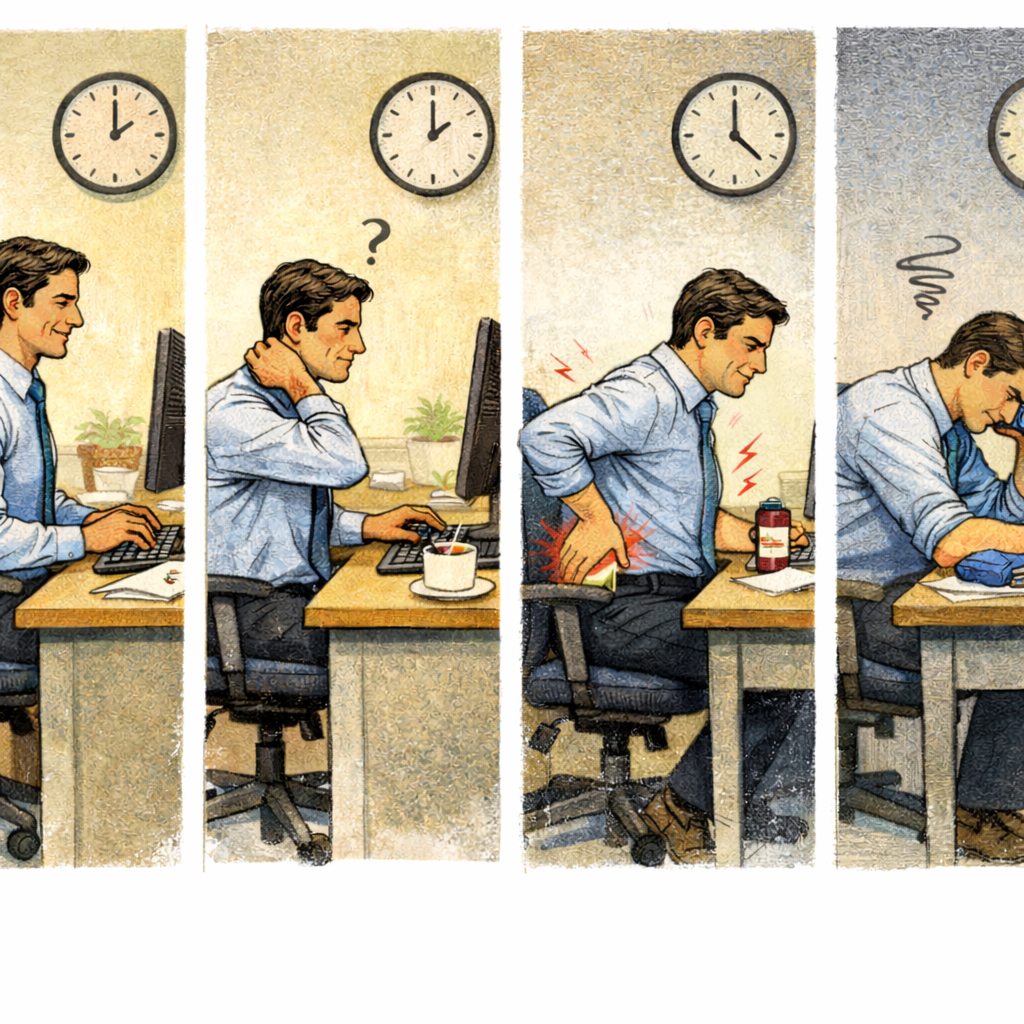
- A steady drop in energy by mid-afternoon
- Increasing lower back tension
- A gradual collapse in posture as the day progresses
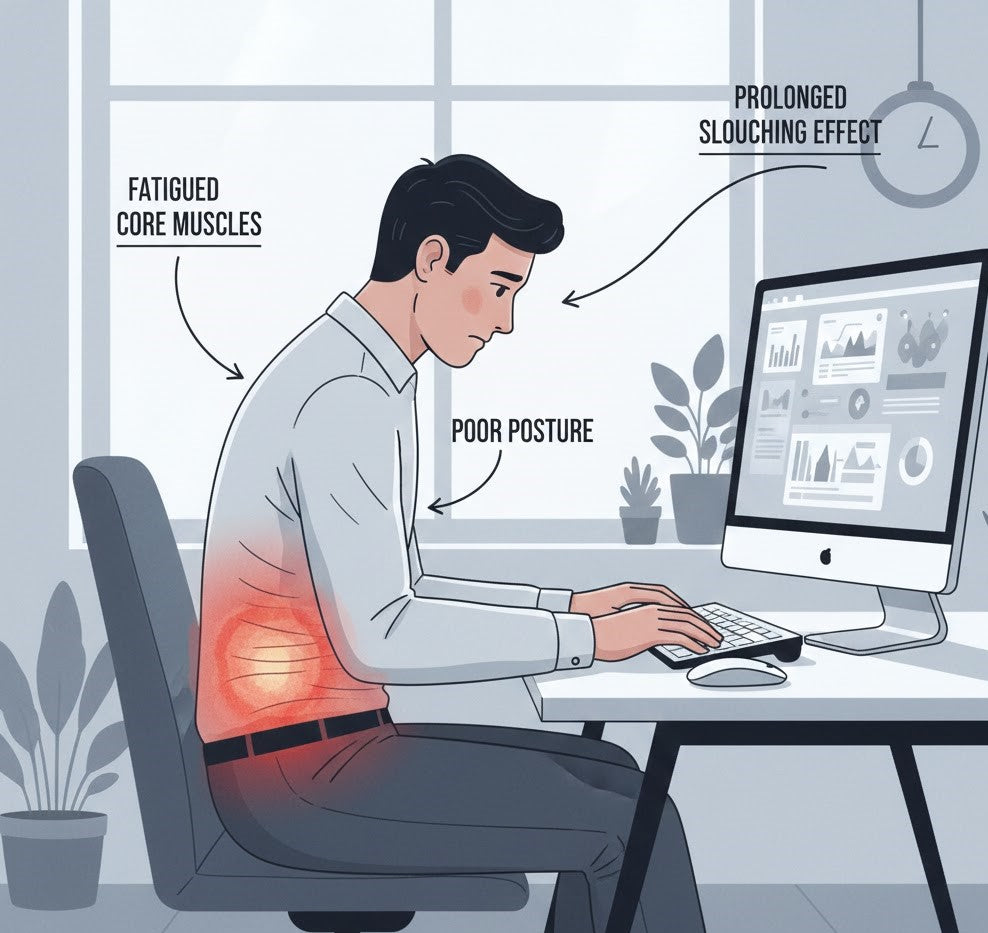
This isn’t just general tiredness—it’s core fatigue, where the muscles responsible for stabilizing your body become overworked from sustained effort.
Understanding this changes how you approach the problem.
Because when the issue is constant muscular compensation, the solution isn’t more effort—it’s better support.

Sitting Shouldn’t Feel This Tiring
Sitting is often assumed to be a low-effort posture—something that allows the body to rest while the mind works.
But if you’ve ever felt more physically drained after a full day at your desk than after being on your feet, you’ve already experienced the disconnect.
When sitting feels exhausting, the cause is rarely a lack of fitness, discipline, or age.
More often, it’s a sign that your body is compensating for missing or inadequate support in your setup.
Without proper structural support, the body has to create its own stability.
The core takes on that role—working continuously to:
- Keep the torso upright
- Prevent collapse
- Protect the lower spine
This effort is subtle, but it never fully stops.
Over time, that constant low-level engagement builds into real fatigue.
This is why sitting can feel surprisingly tiring.
Not because you’re inactive—but because your muscles are doing work they were never meant to sustain for hours at a time.

Why Your Body Wasn’t Designed to Hold Itself Up All Day
When you’re standing or moving, your body relies primarily on its skeletal structure for support.
Bones and joints are designed to stack efficiently, allowing weight to transfer through the body with minimal effort. Muscles engage when needed, then relax—creating a natural rhythm of support and recovery.
Sitting for long periods disrupts this balance.
In a seated position:
- Movement is significantly reduced
- Natural alignment begins to shift
- Stabilizing muscles stay active for longer than intended
- Body weight is distributed differently, increasing demand on the spine
Without enough movement—or proper external support—the body has to compensate.
Instead of relying on structure, it relies on muscle.
The core, in particular, is forced to stay engaged continuously to keep the body upright and stable.
Over time, this creates a problem.
Muscles that are designed for short, responsive activity are now performing a constant, low-level task with no real opportunity to recover.
As fatigue builds:
- Posture begins to break down
- The spine loses alignment
- Passive structures like ligaments and discs begin to take on more load
This is where discomfort starts to appear.
Not because sitting itself is harmful—but because unsupported sitting shifts the workload away from the skeleton and onto muscles that aren’t meant to carry it all day.
And once that shift happens, fatigue begins to accumulate—often long before the workday is over.

What Your Core Muscles Are Actually Doing While You Sit
It’s easy to assume that sitting allows your core to relax.
But in most desk setups—especially those without proper support—that’s not what’s happening.
When lumbar support is missing or insufficient, your body has to create its own stability.
The core takes over.
Research measuring trunk muscle activity (using tools like electromyography, or EMG) shows that core muscles—including deep stabilizers—remain active while you sit in order to:
- Prevent the torso from collapsing forward
- Protect the lower spine
- Maintain balance over the hips
This effort isn’t obvious.
It’s not a strong contraction or something you consciously feel—it’s a low-level, continuous engagement running in the background.
But that’s exactly the issue.
Because while each moment feels insignificant, the effort never fully stops.
Over hours of sitting, this constant activation builds into real fatigue.
The core is designed to support movement—responding dynamically as you bend, shift, and rotate.
It’s not designed to act as a constant bracing system for prolonged, static postures.
So if you’ve ever wondered:
“Is my core supposed to be working this much while I sit?”
The answer is:
Some engagement is normal—but continuous effort is not.
When your core has to stay active just to keep you upright, it’s compensating for missing structural support.

The Hidden Cost of Sitting Up Straight All Day
“Sit up straight” is one of the most common posture tips.
But what it misses is how the body actually maintains posture over time.
Holding yourself upright through muscle effort alone isn’t sustainable.
At first, it may feel manageable—even correct.
But as the hours pass, the muscles responsible for keeping you upright begin to fatigue—especially when they’re working without support.
In practice, the pattern often looks like this:
- You consciously correct your posture and sit upright
- Your muscles gradually tire
- Your posture begins to collapse
- Discomfort starts to build
- You overcorrect again to sit “properly”
And the cycle repeats.
Instead of creating better posture, this leads to something else entirely: posture fatigue.
Your body is constantly shifting between effort and collapse—never fully supported, never fully at rest.
Over time, this repeated cycle places continuous demand on your core and stabilizing muscles.
Not because they’re weak—but because they’re being asked to do too much for too long.
When posture depends on effort alone, fatigue is inevitable.
And eventually, your body will choose relief over precision—even if that means slouching or settling into positions that feel better in the moment but lead to more discomfort later.

Why Even a Strong Core Gets Fatigued at a Desk
This is often surprising—especially if you exercise regularly or have a strong core.
You might expect that strength would prevent discomfort from sitting.
But in reality, it doesn’t.
The reason comes down to the difference between strength and sustained effort.
Strength allows muscles to produce force for short periods.
But sitting places a different kind of demand on the body:
low-level effort, sustained over hours, with little opportunity to rest.
Even strong muscles aren’t designed for that.
A simple way to understand this:
Imagine holding a light object out in front of you.
It’s not heavy—but after a few minutes, your arm starts to fatigue.
Not because it’s weak—but because it’s being asked to hold a position continuously.
Sitting without proper support creates the same condition.
Your core is not working hard—but it is working constantly.
And over time, that constant demand leads to fatigue.
This is why even physically active individuals can experience:
- Lower back discomfort
- Posture breakdown
- Midday fatigue from sitting
The issue isn’t a lack of strength.
It’s a mismatch between what your body is being asked to do—and how it’s being supported while doing it.

How Poor Lumbar Support Forces Your Core to Compensate
This is where support becomes the missing piece.
When proper lumbar support is absent, your body loses its natural foundation.
The pelvis begins to tilt backward.
The natural curve of the lower spine flattens.
And the torso can no longer stay balanced with minimal effort.
At that point, the body has to compensate.
Instead of relying on structure, it relies on muscle.
The core is recruited continuously to:
- Keep the body upright
- Prevent collapse
- Stabilize the spine
Over time, this leads to a familiar pattern:
- Increasing lower back discomfort as the day progresses
- Fatigue in the core and hips
- More effort required just to maintain posture
The key issue isn’t posture awareness—it’s missing support.
When proper support is introduced, everything changes.
The pelvis remains stable.
The spine maintains its natural curve.
And the body can rely on its structure instead of constant muscular effort.
This is where targeted lumbar support makes a meaningful difference.
The Serenform Atlas Lumbar Pillow is designed to support the lower back in a neutral position—restoring alignment and reducing the need for continuous core engagement.
Instead of forcing your body to hold itself upright, it provides the support that allows your core to relax and function as intended.
Reduce Core Strain at the Source

Muscle Imbalances You Didn’t Know You Had
Muscle imbalances are a common—but often overlooked—result of prolonged sitting.
Over time, the body adapts to how it’s positioned throughout the day.
Some muscles become underactive, while others tighten and overcompensate.
In a typical desk setup:
- Deep core muscles may become less effective at stabilizing the spine
- Hip flexors and quadriceps can tighten from prolonged sitting
- The pelvis is gradually pulled out of alignment
This creates a chain reaction.
As alignment shifts, the body loses its ability to support itself efficiently—forcing other muscles to work harder to maintain stability.
The result is familiar:
- Increased tension in the lower back and hips
- Faster onset of fatigue
- Greater difficulty maintaining good posture
While exercises and stretching can help address these imbalances over time, they don’t solve the issue during the workday itself.
If your sitting position continues to place your body under strain, the same patterns will keep repeating.
That’s why addressing how your body is supported while you sit is essential.
When your pelvis and spine are properly supported, your muscles no longer need to compensate—and imbalances are less likely to develop in the first place.

Support vs Comfort: Why Softness Alone Isn’t Enough
Comfort is often mistaken for softness.
But when it comes to sitting for long periods, softness alone doesn’t reduce strain—it can actually contribute to it.
A soft cushion may feel comfortable at first.
But over time, it compresses.
As it does:
- The pelvis loses stability
- Posture begins to collapse
- The spine drifts out of alignment
When that happens, the body has to compensate.
Once again, your muscles—especially your core—are forced to step in and do the work that proper support should be handling.
This is why short-term comfort often leads to long-term discomfort.
Effective ergonomic support is built on three key principles:
- Maintaining proper alignment
- Distributing pressure evenly
- Preserving the spine’s natural curves
A well-designed cushion doesn’t just feel comfortable—it supports how your body sits.
The Serenform Summit Seat Cushion is designed with this balance in mind.
Its structured, contoured design helps stabilize the pelvis and reduce pressure at key points—allowing your spine to stay aligned without constant effort.
True comfort comes from support.
Not from how soft something feels in the moment—but from how well it reduces the work your body has to do over time.

What Proper Support Changes by Mid-Afternoon
The impact of proper support becomes most noticeable as the day goes on.
Instead of gradually wearing down, your body stays more stable—with far less effort.
With proper support in place, the difference is clear:
- Less tension building in the lower back
- More consistent posture without constant correction
- Reduced overall fatigue from sitting
- Better focus and mental clarity in the afternoon
Instead of feeling physically drained by mid-day, your body maintains alignment more naturally.
The energy that was previously used to hold yourself upright is no longer wasted on constant muscular effort.
That shift changes how the entire workday feels.
Instead of:
- Adjusting your posture repeatedly
- Pushing through discomfort
- Losing focus as fatigue builds
You’re able to sit with more stability, less effort, and greater consistency.
This is the difference between temporary comfort and sustainable support.
Not just getting through the workday—but maintaining comfort and focus from start to finish.

The Benefits of Microbreaks (and How to Use Them Effectively)
One of the simplest ways to reduce the strain of prolonged sitting is to take short, regular breaks.
Even brief movement—every 30 to 60 minutes—can help your body reset.
Microbreaks allow your muscles, especially your core, to:
- Relax and recover
- Reduce built-up tension
- Improve circulation
Simple actions like standing, stretching, or walking for a few minutes can make a noticeable difference in how your body feels by the end of the day.
However, breaks alone don’t fully solve the problem.
If your sitting position continues to require constant muscular effort, fatigue will return as soon as you sit back down.
That’s why microbreaks work best when combined with proper support.
When your body is supported while sitting, and given regular opportunities to reset, strain is reduced both during and between work sessions.

The Role of Physical Activity in Reducing Core Fatigue
Regular physical activity plays an important role in maintaining overall strength and reducing muscle tension.
Movement helps your core function as intended—supporting stability during dynamic activity rather than being locked into a constant, low-level effort.
Activities like walking, strength training, or simple stretching can:
- Improve core stability
- Reduce built-up muscle tension
- Break up long periods of inactivity
Over time, this supports better posture and overall physical resilience.
However, physical activity alone doesn’t solve the problem of prolonged sitting.
Even if you exercise regularly, your body still spends hours each day in a seated position.
If that position lacks proper support, your core will continue to compensate—and fatigue will return.
That’s why daily sitting conditions matter just as much as movement.
When your body is properly supported while you sit, and reinforced by regular activity, the overall strain on your muscles is significantly reduced.

Supporting Your Body Beyond the Desk
Reducing muscle fatigue doesn’t stop when the workday ends.
Your overall habits—like staying active, getting enough rest, and managing stress—play an important role in how your body feels day to day.
Simple habits such as:
- Regular movement
- Quality sleep
- Occasional stretching or light activity
can help your body recover from the demands of prolonged sitting.
However, these habits work best when combined with proper support during the hours you spend seated.
Because even with a healthy lifestyle, your body still experiences the same daily demands at your desk.
Improving how you sit—along with how you move—creates a more complete and sustainable approach to reducing fatigue and discomfort.

Sitting Doesn’t Have to Be a Core Workout
Sitting shouldn’t feel like effort.
It shouldn’t require constant correction, muscle bracing, or ongoing awareness just to stay upright.
But without proper support, that’s exactly what happens.
Your core is forced to stay active—not to assist movement, but simply to keep your body from collapsing.
When support is in place, that changes.
Instead of compensating for missing structure, your core returns to its intended role—providing stability when needed, without staying under constant strain.
The spine stays aligned through support, not effort.
And that shift is noticeable.
Sitting feels lighter.
Posture becomes easier to maintain.
Fatigue builds more slowly throughout the day.
Even small improvements in how your body is supported can significantly reduce the physical demands of sitting.
Over time, this turns sitting from something you endure into something your body can sustain comfortably.

When Your Body Is Supported, Your Core Can Relax
If your core feels overworked during the workday, it’s not a sign of poor discipline or lack of strength.
It’s a signal that your body is compensating for missing support.
When that support is absent, your muscles are forced to take on roles they were never designed to sustain.
The core, in particular, works continuously to stabilize the body and protect the spine.
Over time, that constant effort leads to fatigue, discomfort, and the gradual breakdown of posture.
But when proper support is restored, the dynamic changes completely.
Your body no longer has to rely on constant muscular effort to stay upright.
Instead:
- The spine is supported in its natural position
- The pelvis remains stable
- The core is free to assist, rather than compensate
And the difference is immediate.
Sitting feels easier.
Posture becomes more consistent.
Fatigue no longer builds as quickly throughout the day.
Instead of pushing through discomfort, you’re able to sit with less effort—and focus on your work without distraction.
Because when your body is properly supported,
your core doesn’t have to work overtime just to keep you upright.
Sit With Less Effort Starting Today