Why Stretching Doesn't Fix Back Pain
If you spend most of your day at a desk, stretching is likely already part of your routine.
You ease your neck between meetings.
You roll your shoulders after long stretches of emails.
You stand up at the end of the day and stretch your hamstrings, hoping to release the tension that’s built up over hours of sitting.
For a brief moment, it helps. Your body feels lighter. The discomfort softens.
Then you sit back down—and gradually, the same tightness and strain return.
This pattern is incredibly common among desk workers, and it isn’t a sign that you’re doing anything wrong. Stretching serves an important purpose, but on its own, it isn’t designed to resolve desk-related pain. The issue has less to do with a lack of flexibility and far more to do with what your body experiences during the many hours you remain seated.
When the body is repeatedly asked to sit without adequate support, stretching becomes a temporary reset rather than a lasting solution. It's important to focus on the underlying causes of desk pain, not just on stretching.

“I Stretch Every Day—So Why Does My Body Still Hurt?”
This question comes up frequently among people who spend long hours at a desk.
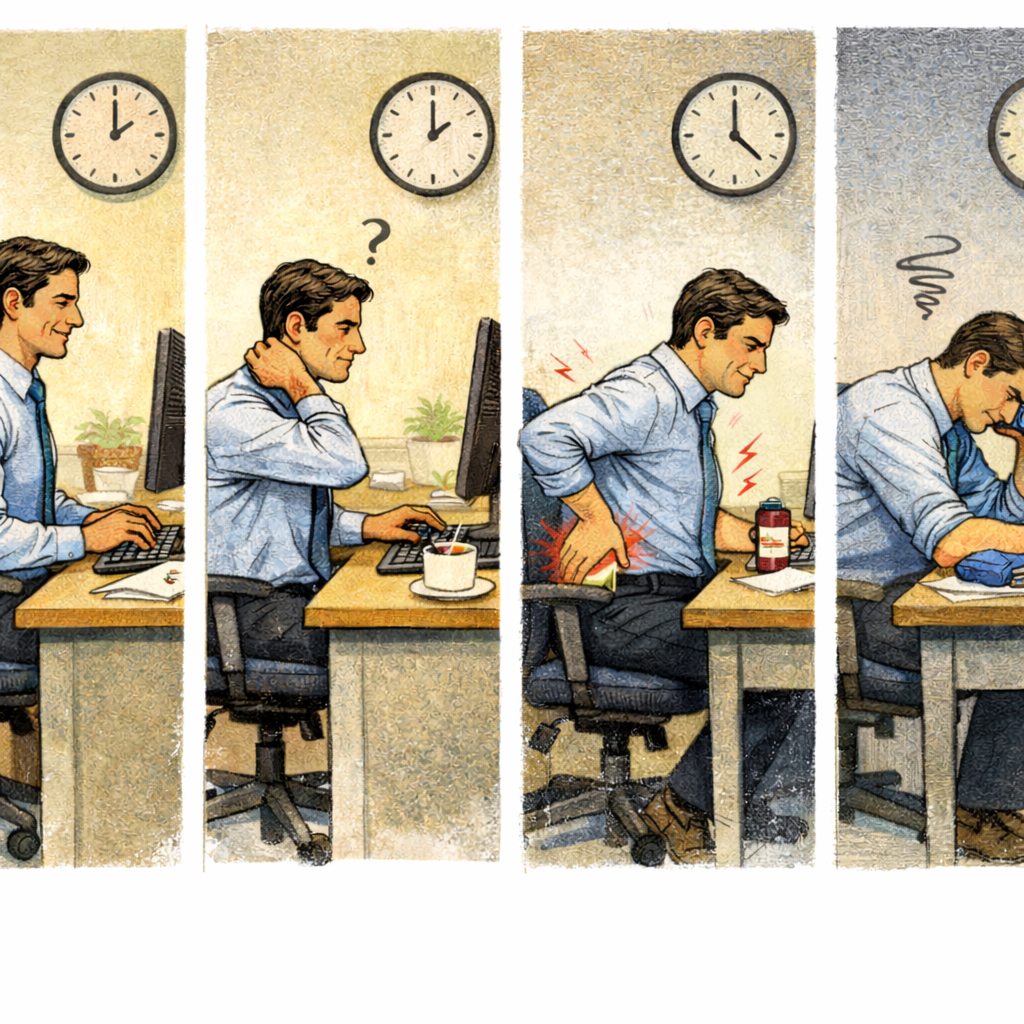
You may be physically active. You may stretch consistently throughout the day. You might even exercise regularly outside of work. Yet despite these efforts, discomfort still emerges—often by mid-afternoon. The lower back begins to ache. The neck feels tight. The shoulders grow heavy and tense. Over time, the pain can feel persistent and difficult to explain.
The key distinction lies in what stretching is designed to do.
Stretching offers temporary relief, not structural change. It allows muscles to relax, improves circulation, and helps calm an overactive nervous system. These effects are valuable—but they are also short-lived. When you return to the same seated position without adequate support, the body is exposed to the same mechanical demands, and the same strain begins to accumulate again.
When desk pain returns despite regular stretching, it does not mean stretching has failed or that your body is unusually resistant. It is a signal that the conditions of sitting itself have not been addressed. Unless you adjust your sitting environment or support, the body must continually compensate, and no amount of post-work stretching can fully counteract hours of unsupported sitting.

Why Stretching Feels Good (But Only Temporarily)
Stretching is effective at what it is designed to do: reduce short-term muscular tension.
When you stretch, several helpful things happen at once. Tight muscles are gently lengthened, circulation improves, and the nervous system shifts out of a protective or “guarded” state. This combination often produces an immediate sense of relief—less stiffness, less pressure, and a temporary feeling of ease.
This is why stretching can feel so reassuring. It provides quick feedback that something positive is happening in the body.
However, stretching has clear limitations—especially when it comes to desk-related pain.
Stretching does not reduce ongoing spinal compression. It does not change how your body weight is distributed while you sit. And it does not provide structural support to the lower back or pelvis, where much of the strain from prolonged sitting accumulates.
As a result, while stretching can calm symptoms, it does not alter the conditions that created those symptoms in the first place. Once you return to the same unsupported seated position, the same mechanical demands are placed on the body, and tension begins to build again.
This is why the relief from stretching often fades quickly—not because stretching is ineffective, but because the source of the strain remains unchanged.

The Real Problem Isn’t Tight Muscles—It’s Unsupported Sitting
Desk pain is often blamed on tight muscles, but in many cases, muscle tightness is not the root problem—it is the body’s response to an ongoing mechanical demand.
When you sit for extended periods without adequate support, your body must compensate in subtle but continuous ways. The spine is placed under sustained load, the pelvis may gradually tilt backward, and the muscles of the core and lower back remain lightly activated to keep you upright. This level of constant effort is rarely noticeable at first, but it accumulates over time.
As the hours pass, these muscles begin to fatigue. Fatigued muscles lose efficiency and respond by tightening, creating stiffness and discomfort. What feels like a flexibility issue is often the result of muscles working longer and harder than they were designed to.
This scenario is commonly described as unsupported sitting—a state in which the body is forced to provide its own structural stability instead of receiving it from the chair and surrounding environment. In this condition, the body functions as its own support system, with muscles compensating for the absence of proper alignment and load distribution. Some posture correction methods attempt to address this by pulling the shoulders back to prevent slouching, but this does not address the underlying lack of support.
Stretching can temporarily ease the tension that results from this process, but it cannot replace the missing structural support during the many hours spent seated. Without addressing how the body is supported while sitting, the same pattern of fatigue and tightness is likely to repeat each day.

Why Stretching Can’t Undo Eight Hours at a Desk
Stretching is inherently reactive. Sitting, on the other hand, is repetitive and sustained.
Most desk workers stretch for a few minutes at a time—perhaps five to fifteen minutes spread throughout the day or reserved for the end of the workday. In contrast, sitting often occurs in the same position for six, eight, or even ten hours. This imbalance between relief and exposure plays a significant role in why discomfort persists.
Stretching after work can be helpful, but it cannot counteract the cumulative effects of prolonged unsupported sitting. A useful way to think about it is this: stretching is like wringing out a towel while the faucet is still running. The moment you sit back down, your body re-enters the same environment that created the strain in the first place, and the process begins again.
This is why desk pain so often returns, even with consistent stretching:
-
The underlying cause remains unchanged
-
The duration of strain far exceeds the duration of relief
-
The body’s recovery simply cannot keep pace with the ongoing demand
The issue is not a lack of effort or discipline. It is a matter of timing and support. When the body spends most of the day in a position that requires constant muscular compensation, short periods of recovery are rarely enough to offset the load.

Why “Sitting Up Straight” and Constant Correction Don’t Work
When stretching fails to resolve desk pain, the next strategy many people adopt is posture correction. They make a conscious effort throughout the day to sit up straighter, pull their shoulders back, and actively engage their core while working.
Initially, this approach can feel helpful. Posture improves, discomfort may decrease briefly, and there is a sense of control over the problem. Over time, however, this constant self-correction becomes difficult to maintain—and often exhausting.
The reason is simple: holding posture through conscious effort requires continuous muscular activation. The core, lower back, shoulders, and upper spine remain engaged for hours at a time. Instead of allowing the body to rest while seated, sitting becomes a form of low-level exercise.
As the day progresses, this sustained effort frequently leads to:
-
Core fatigue and diminished endurance
-
Increased tension in the back and shoulders
-
Greater stiffness and discomfort by the end of the workday
Good posture is not meant to be something you actively “hold” all day. When alignment depends entirely on effort and vigilance, it is rarely sustainable over long periods. True sitting comfort comes from reducing the amount of work your muscles must do—not increasing it.

Posture Stabilization vs. Posture Control
This is where an important distinction often gets overlooked.
Posture control depends on muscles doing nearly all the work. It requires constant awareness and continuous muscular engagement to maintain alignment throughout the day. While this approach can be effective in short bursts, it places a sustained demand on the body that is difficult to maintain over long periods of sitting.
Posture stabilization, by contrast, relies on structure sharing the load. When the body is properly supported, alignment no longer depends solely on muscular effort. The spine is guided into a more natural position, allowing muscles to support movement rather than compensate for missing support.
With effective posture stabilization:
-
The spine maintains its natural curves with less effort
-
Muscles assist alignment instead of holding it in place
-
Sitting feels lighter and more sustainable, not more demanding
Support does not force the body into position. Instead, it restores the conditions that allow good posture to emerge naturally.
This principle is central to ergonomic tools such as the Serenform Atlas Lumbar Pillow, which is designed to support the natural curve of the lower back. By providing targeted lumbar support, it reduces the need for constant muscular engagement, allowing the body to relax while remaining properly aligned.
When posture is stabilized through support, alignment becomes the outcome—not the task.

Why Support During Sitting Matters More Than Stretching After
Stretching plays an important role in recovery. It helps muscles relax, restores mobility, and supports circulation after periods of inactivity. But recovery alone cannot offset what the body experiences during prolonged sitting.
Support, by contrast, influences what happens while the strain is occurring.
Effective ergonomic support works by reducing the ongoing demands placed on the body throughout the workday. Specifically, it helps:
-
Decrease continuous spinal load during seated work
-
Distribute pressure more evenly across the pelvis and spine
-
Reduce the need for muscles to overcompensate to maintain alignment
This is why lasting desk pain relief comes from improving the environment your body occupies for most of the day—not only from what you do before or after sitting. When support is present during the hours you are seated, the body accumulates less strain in the first place.
Integrated systems such as the Serenform Posture Support Bundle are designed with this principle in mind. By stabilizing both the seat and the spine together, these systems address the most common sources of sitting fatigue simultaneously, rather than treating them in isolation.
There is no force involved and no need for constant self-correction. Just thoughtful structure placed where the body needs it most.

Stretching Still Matters—But It Can’t Do This Alone
Stretching is not ineffective, nor is it something that should be eliminated from a healthy routine. Its role, however, is often misunderstood. Stretching is a valuable tool—but it is incomplete when used on its own to address desk-related discomfort.
When used appropriately, stretching:
-
Supports joint mobility and range of motion
-
Encourages healthy circulation after prolonged sitting
-
Helps muscles recover from sustained or repetitive effort
These benefits are important, particularly for maintaining movement quality and reducing stiffness. However, stretching works best when the body is not being continually overloaded throughout the day.
If prolonged sitting remains unsupported, stretching becomes a temporary reset rather than a lasting solution. The strain simply rebuilds once seated work resumes.
The most sustainable approach pairs recovery with prevention. This means combining:
-
Support during sitting, which reduces ongoing mechanical demand
-
Movement and stretching, which assist the body in recovering and resetting
One strategy prevents overload from accumulating in the first place. The other helps the body restore balance after activity. Together, they create a more effective and realistic path to long-term sitting comfort.

Expert Insights: What Orthopedic Specialists Recommend for Desk Workers
Orthopedic specialists agree: the foundation of orthopedic health for desk workers is maintaining good posture throughout the workday. Poor posture—like slouching, bending forward, or sitting at a desk without proper support—can lead to neck pain, back pain, and tight muscles in the upper back, shoulders, and hips. Over time, these issues can develop into more serious musculoskeletal disorders, making posture correction a top priority for anyone spending longer periods at a desk.
To maintain good posture, experts recommend starting with the basics of proper alignment. Sit upright with your feet flat on the floor, knees at a right angle, and your chair adjusted so your arms rest comfortably at arm’s length from your keyboard. Keep your shoulders relaxed, shoulder blades gently pulled back and down, and your upper body supported by engaging your abdominal muscles. Using a lumbar support pillow or a chair with built-in lumbar support can help keep your spine in a neutral position, reducing strain on your lower back and hips.
A posture corrector can be a valuable tool for those who struggle with constant adjustment or find themselves slipping into poor posture as the day goes on. The best posture correctors—whether they’re shoulder straps, back braces, or lumbar cushions—are designed for extended wear, offering support without restricting movement or causing discomfort. Look for product details like breathable material, adjustability, and compatibility with different body types to stay comfortable and protected throughout the day.
Orthopedic specialists also emphasize the importance of movement and exercise in your daily routine. Incorporate stretches, yoga, or targeted exercises to strengthen the muscle groups that support good posture, especially the core and upper back. Taking a short walk every hour, standing up to stretch, or simply adjusting your position can help reduce tension and prevent tight muscles from developing. Even small changes, like using a wrist rest or adjusting your monitor to eye level, can make a significant difference in reducing strain and supporting your overall health.
Finally, regular check-ins with a healthcare provider or physical therapist can help you identify any posture issues early and receive personalized advice for posture correction. They can recommend specific exercises, stretches, or posture correctors tailored to your needs, helping you relieve discomfort and protect your joints and spine from injury.
By following these expert recommendations—focusing on support, movement, and proper alignment—desk workers can reduce pain, relieve tension, and maintain good posture for better orthopedic health and overall well-being

Conclusion: Lasting Relief Comes From Supporting the Body While You Sit
Desk-related discomfort is rarely a failure of flexibility or effort. More often, it is a signal that the body is spending long hours without the support it needs.
Stretching can play an important role in helping the body feel better in the short term. It promotes recovery, eases tension, and supports healthy movement. However, lasting comfort depends on what the body experiences during the many hours spent seated each day. When the sitting environment remains unsupported, strain continues to accumulate regardless of how diligently you stretch.
When proper structure is restored while you sit, the effects are noticeable:
-
Muscles are able to relax instead of constantly compensating
-
Pressure on the spine and surrounding tissues decreases
-
Sitting tolerance improves naturally, without added effort or vigilance
Stretching helps the body recover. Support helps the body endure.
And when your body is supported in a way that respects its natural alignment, sitting no longer feels like something you have to push through. Instead, it becomes an experience your body can sustain—comfortably and consistently—throughout the workday.