Why Sitting Hurts As You Age
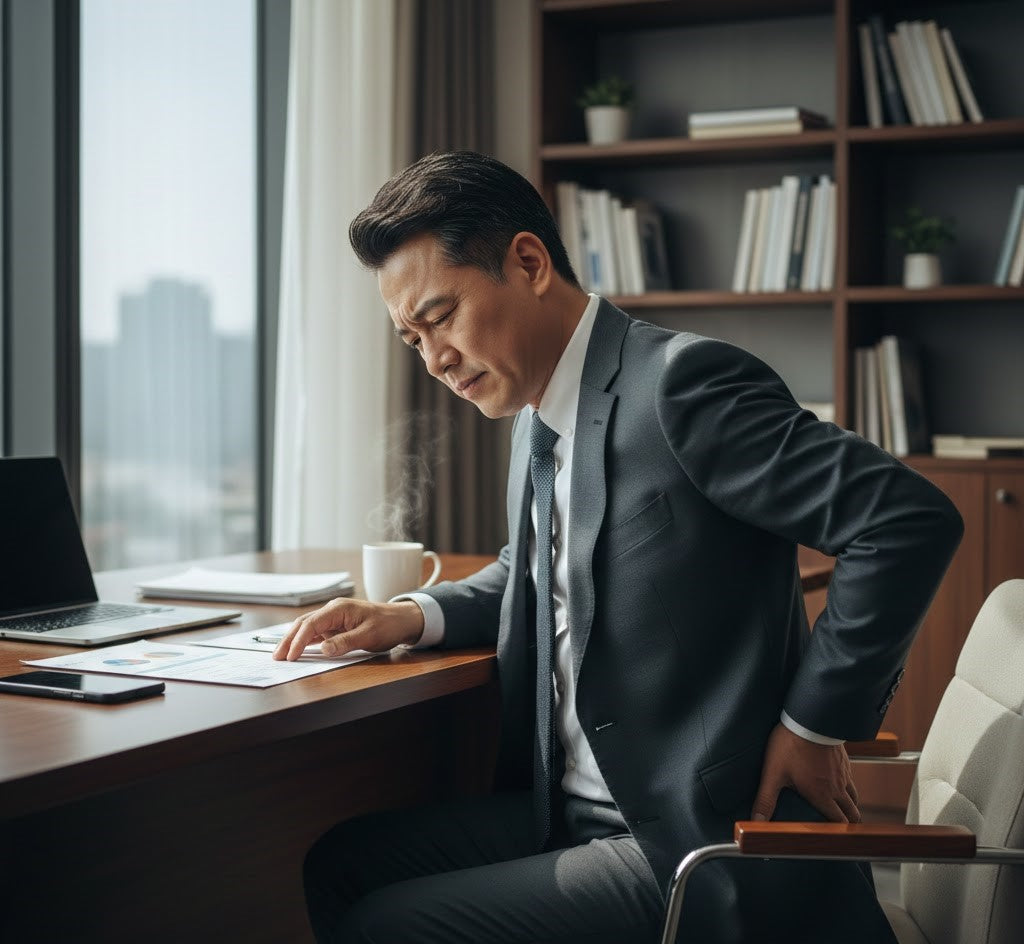
If you’ve ever caught yourself thinking, “Sitting didn’t used to feel this uncomfortable,” you’re not imagining it.
What once felt effortless can gradually become physically demanding—often without any clear reason why.
Your lower back tightens sooner.
Your hips begin to ache after shorter periods.
Sitting upright requires more effort than it used to.
And by the end of the day, both physical discomfort and mental fatigue seem to arrive earlier.
The key reason is often overlooked:
Your body has changed—but your sitting environment hasn’t.
As you age, your joints, spinal discs, and postural muscles respond differently to sustained positions. Joints become more sensitive to pressure, discs lose some of their ability to absorb load, and muscles fatigue more quickly during prolonged sitting.
These are normal, natural changes—not signs of weakness or poor habits.
But they do mean one thing:
The same sitting setup that once felt fine can now create strain much more quickly.
This is why discomfort often appears even when nothing about your routine has changed.
Sitting hasn’t become worse.
Your body simply requires better support than it used to.
Understanding this shift is important.
Because once you recognize that the issue is not effort—but support—you can begin to make adjustments that restore comfort, reduce strain, and make sitting feel sustainable again.

It Didn’t Used to Feel This Hard to Sit
One of the most common—and often frustrating—questions people ask is:
“Why does sitting feel harder than it used to?”
In most cases, there isn’t a clear moment when something changes.
There’s no injury. No sudden shift in routine.
Instead, the discomfort builds gradually.
What once felt neutral or effortless starts to feel demanding—and the reason isn’t always obvious.
The reality is that sitting places continuous, low-level stress on the body.
When you’re younger:
-
Muscles recover quickly
-
Joints tolerate pressure more easily
-
Posture requires very little conscious effort
Your body still functions well—but it becomes less forgiving of long, static positions.
This is why:
-
The same chair feels less comfortable
-
The same posture feels harder to maintain
-
The same workday feels more physically draining
Nothing in your environment has changed.
But your body’s tolerance for sustained sitting has.
Sitting discomfort rarely appears all at once.
It develops gradually, as small amounts of strain accumulate day after day—especially during long desk sessions.
Over time, this can lead to increased stiffness in the joints, reduced mobility, and a growing sense of fatigue while sitting.
Understanding this shift is important.
Because once you recognize that the issue isn’t sudden damage—but gradual adaptation—you can begin to address it in a more effective way.

The Impact of a Sedentary Lifestyle
Spending long hours sitting—whether at a desk, in front of a screen, or during a commute—can gradually change how your body feels and functions.
At first, the effects are subtle.
A bit of stiffness in the hips.
A slight tightness in the lower back.
A tendency to shift positions more often than before.
But over time, these small changes begin to add up.
When sitting becomes a large part of your day:
- Hip flexors tighten from remaining in a shortened position
- Pelvic stability decreases, making posture harder to maintain
- The spine experiences more consistent pressure
- Stiffness develops more quickly, especially after long periods of stillness
This is why discomfort can seem to appear “out of nowhere”—when in reality, it’s been building gradually.
Movement helps interrupt this pattern.
Simple habits like:
- Standing up every hour
- Stretching briefly
- Taking short walks
can improve circulation, reduce stiffness, and help your body reset throughout the day.
But movement alone doesn’t fully solve the problem.
If your sitting setup continues to place uneven pressure on your body, discomfort tends to return just as quickly once you sit back down.
That’s why reducing strain during sitting—not just between sitting—is key to maintaining long-term comfort.
Age Changes the Body—Even When You’re Not Injured
Aging doesn’t mean something is wrong with your body.
It simply means your body begins to respond differently to physical stress—especially the kind that comes from staying in one position for long periods.
Over time, a few important changes naturally occur:
- Joints become more sensitive to pressure, particularly in the hips and lower back
- Spinal discs lose some hydration, reducing their ability to absorb and distribute load
- Connective tissues become less flexible, making it harder to stay comfortable in static positions
These changes happen gradually—and often go unnoticed during movement.
Walking, standing, or light activity may still feel completely normal.
Sitting, however, is different.
It concentrates pressure into a few key areas and asks your body to tolerate that pressure continuously—without relief.
This is why discomfort can develop even without any injury.
You might feel:
- Stiffness during long sitting sessions
- Tightness in the hips or lower back
- A dull ache that builds over time
Even if you’re otherwise active and healthy.
Movement and targeted exercises can help relieve some of this tension.
But when sitting continues to place repeated stress on the same areas, the discomfort tends to return.
This is what makes sitting feel more demanding over time—and why the quality of support becomes increasingly important.

Why Muscle Endurance Declines Before Strength Does
One of the main reasons sitting becomes more difficult over time isn’t a loss of strength—it’s a loss of endurance.
The muscles that keep you upright while sitting—especially your core and postural muscles—are designed for low-intensity, long-duration work.
They’re not meant for bursts of effort.
They’re meant to stay active quietly in the background, stabilizing your spine and pelvis throughout the day.
As your body changes, these muscles often remain strong.
But their ability to sustain that effort over time gradually decreases.
At first, the effects are subtle:
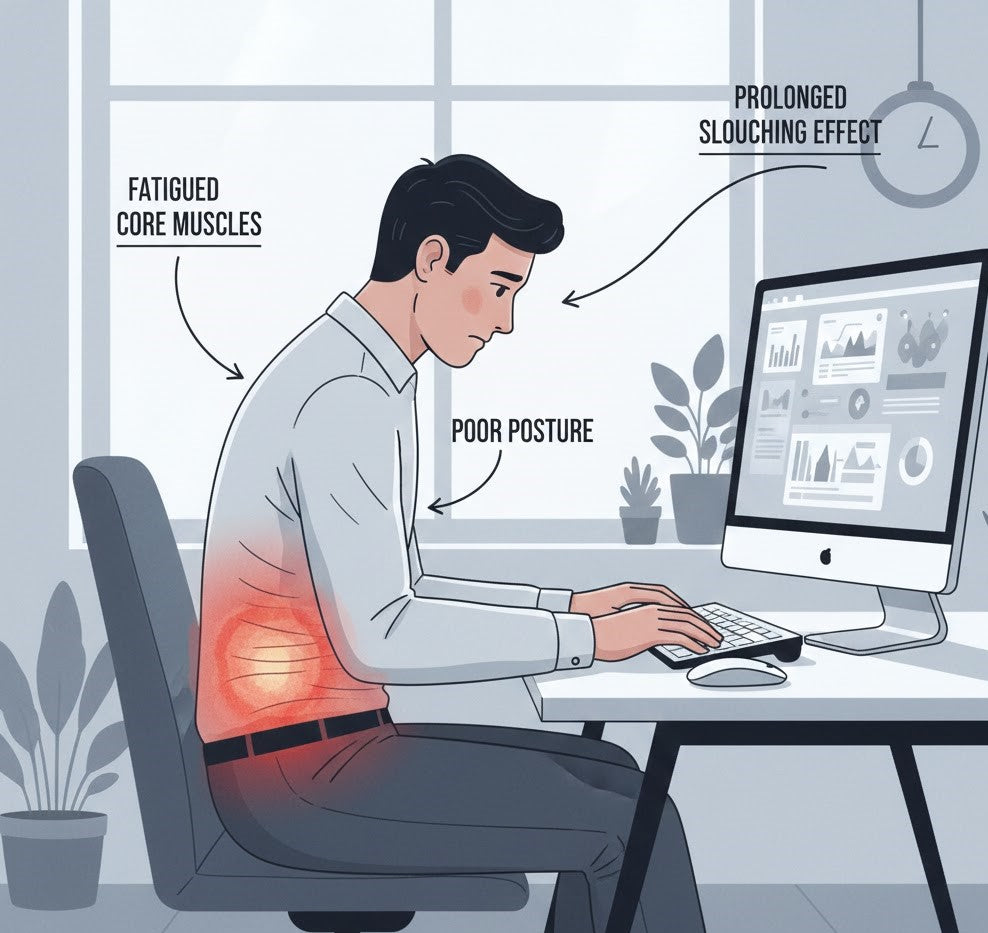
- You start to slouch earlier in the day
- You shift positions more often
- Sitting begins to feel mentally and physically draining
Even though you’re not doing anything physically demanding.
As these muscles fatigue, they provide less support.
When that happens:
- The spine becomes less stable
- Pressure shifts to joints and discs
- Strain begins to build more quickly
Over time, this creates a cycle:
Fatigue → Less support → More strain → More fatigue
This is why sitting often feels exhausting before it becomes painful.
And why relying on effort alone isn’t enough.
To maintain comfort over long periods, your body needs support that reduces the workload on these muscles—not something that depends on them working harder.

Sitting Puts More Pressure on Aging Discs and Hips
Sitting may feel like a low-effort activity—but from a biomechanical standpoint, it places significant and continuous pressure on the body.
Especially during long hours at a desk.
Compared to standing or light movement, prolonged sitting:
- Increases pressure on the lower back (lumbar discs)
- Places continuous load on the hips
- Concentrates force through the tailbone and base of the spine
These areas end up carrying most of your body weight—without much variation or relief.
As your body changes over time, this becomes more noticeable.
Spinal discs gradually lose some of their hydration and elasticity. While they still function, they become less effective at absorbing and distributing pressure.
This means that even when your posture looks “correct,” your body is handling that pressure less efficiently than before.
The result?
- Pressure builds more quickly
- Discomfort appears sooner
- Recovery takes longer after you stand or move
This is why:
- Lower back pressure becomes more noticeable
- Hip discomfort develops during long sitting sessions
- Tailbone sensitivity increases over time
In some cases, standing may even feel more comfortable—not because it’s effortless, but because it distributes load more evenly and reduces constant pressure on a few key areas.
This is the key shift to understand:
As you age, managing pressure becomes more important than simply maintaining posture.
Because when pressure is reduced:
- The spine experiences less strain
- The hips carry load more comfortably
- Sitting becomes more sustainable over time

Managing Neck Pain
Neck pain is often treated as an isolated issue—but in many cases, it starts lower in the body.
When you sit for long periods without proper support, the problem doesn’t begin in the neck—it begins in your posture.
As sitting posture breaks down:
- The pelvis tilts backward
- The spine loses its natural alignment
- The upper body shifts forward
- The head moves out of position
This creates a chain reaction.
To compensate, the neck muscles are forced to work harder to support the head—leading to tension, stiffness, and discomfort over time.
Why Neck Pain Builds Gradually
Unlike sudden injuries, posture-related neck pain develops slowly.
You may notice:
- Tightness after long work sessions
- A forward head position while using screens
- Fatigue in the neck and shoulders by the end of the day
How to Reduce Neck Strain While Sitting
Small adjustments can help reduce this buildup:
- Keep your screen at eye level
- Avoid leaning your head forward
- Take short movement breaks throughout the day
But the most important factor is supporting your posture at the foundation.
Support Starts Lower Than You Think
When your lower body is properly supported:
- The pelvis stays stable
- The spine maintains its natural curve
- The head remains aligned with less effort
This reduces the workload on the neck—helping prevent strain before it builds.
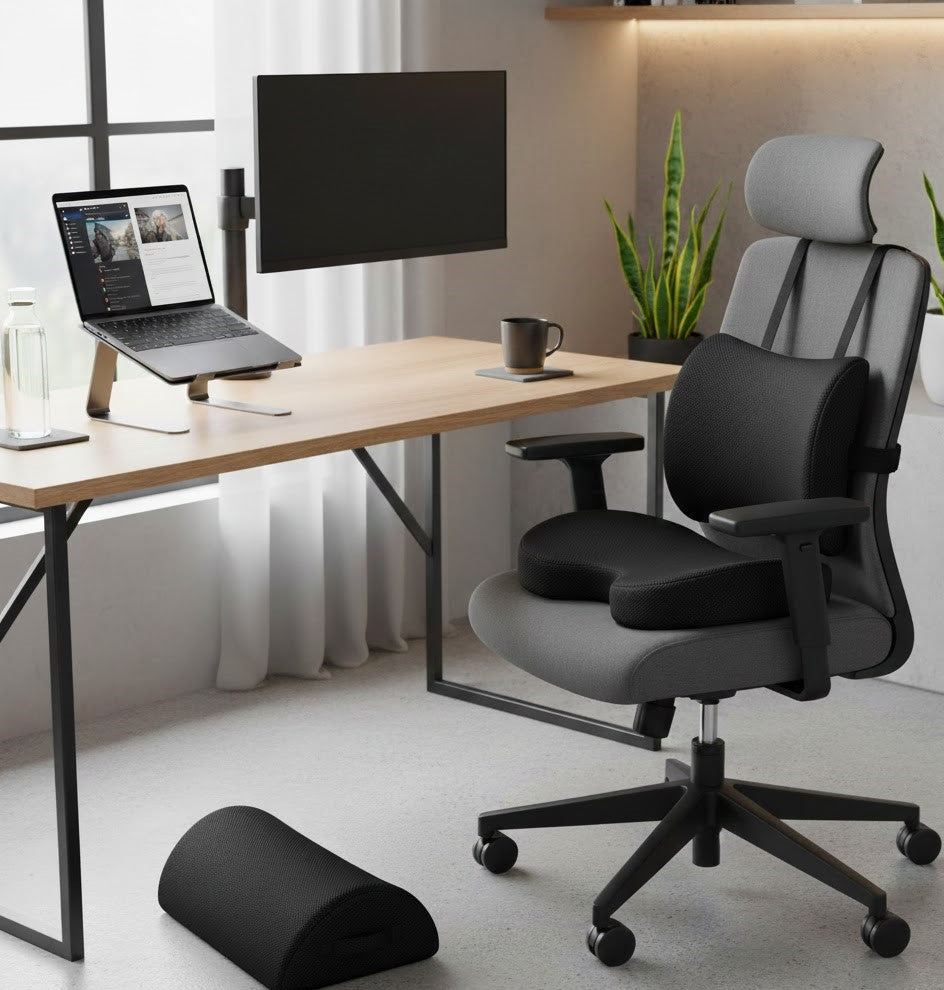
The Serenform Atlas Lumbar Pillow supports the lower back, helping maintain proper spinal alignment.
Paired with the Serenform Summit Seat Cushion, which stabilizes the pelvis and reduces pressure, the body is better positioned from the ground up.
Instead of correcting posture constantly, your setup supports it—making it easier to sit comfortably without placing excess strain on your neck.

Foot Pain: The Overlooked Effect of Poor Sitting Support
When people think about discomfort from sitting, they usually focus on the back or hips.
But foot discomfort is another common—and often overlooked—result of poor sitting mechanics.
Even while seated, your feet play an important role in stabilizing your posture.
When your sitting position is unsupported:
- Weight distribution becomes uneven
- The pelvis shifts out of alignment
- Pressure travels down through the legs into the feet
Over time, this can lead to:
- Pressure buildup in the soles of the feet
- Reduced circulation in the lower legs
- A feeling of stiffness or discomfort after sitting
Why It’s Often Missed
Foot discomfort doesn’t always appear immediately.
Instead, it builds gradually—especially during long sitting sessions where posture begins to break down.
How to Reduce Foot Strain While Sitting
Simple adjustments can help:
- Keep your feet flat and fully supported
- Avoid tucking your legs under your chair
- Take short breaks to stand and reset circulation
But just like with back and neck discomfort, the root issue often starts higher up.
Support Starts at the Foundation
When your pelvis and hips are properly supported:
- Weight is distributed more evenly
- The spine remains aligned
- Less strain travels down into the legs and feet
The Serenform Summit Seat Cushion helps stabilize your sitting position and reduce uneven pressure at the source.
When combined with proper lower back support, your entire posture becomes more balanced—reducing strain not just in the back, but throughout the body.

Why “Good Posture” Isn’t Enough Anymore
You’ve probably heard it before:
“Just sit up straight.”
It sounds simple—but it overlooks how the body actually works, especially over time.
Maintaining good posture isn’t passive.
It requires continuous effort from the muscles of your back, core, and hips—along with support from your shoulders and upper body to stay properly aligned.
When you’re younger, this effort feels almost automatic.
But as muscle endurance gradually decreases, holding that position for long periods becomes more difficult—even if you’re strong and otherwise healthy.
This is why:
- You start to slouch earlier in the day
- Sitting upright feels tiring instead of natural
- Discomfort returns even when you try to “fix” your posture
The problem isn’t awareness.
It’s that posture alone doesn’t reduce the load on your body.
It simply shifts that load onto your muscles.
And when those muscles fatigue:
- Support decreases
- Posture breaks down
- Pressure shifts to the spine and joints
This is where most advice falls short.
Because what your body needs isn’t more effort.
It needs better support.
Proper support:
- Reduces the workload on your muscles
- Maintains alignment more naturally
- Decreases pressure on joints and discs
Instead of forcing yourself to sit correctly,
your setup helps you stay aligned without constant effort.

Why Support Matters More as You Age
Ergonomics isn’t about fixing your body.
It’s about adapting your environment so your body can function with less effort—especially as its needs change over time.
When sitting support is lacking, your body compensates.
- Muscles work harder to keep you upright
- Joints absorb more pressure than they should
- Fatigue builds faster throughout the day
When support improves, the opposite happens.
Your body no longer has to fight to maintain alignment.
Instead:
- Posture becomes more natural
- Pressure is distributed more evenly
- Sitting requires less effort
This is why support becomes more important over time.
Not because the body is weaker—but because it benefits more from efficient load distribution.
What Proper Support Actually Does
Well-designed ergonomic support helps:
- Reduce pressure on spinal discs, minimizing compression over time
- Decrease muscle fatigue, especially in postural muscles
- Improve sitting endurance, so discomfort builds more slowly
- Preserve energy, making it easier to stay focused and productive
Even small improvements in support can lead to noticeable changes in how your body feels throughout the day.
Movement and short breaks still matter.
But without proper support while sitting, strain tends to return just as quickly.
Why the Right Tools Make a Difference
This is where targeted ergonomic support becomes essential.
Tools like the Serenform Summit Seat Cushion and Atlas Lumbar Pillow are designed to:
- Reduce pressure at key points
- Support natural alignment from the base of the spine
- Make sitting feel more stable and less demanding
Instead of constantly adjusting your posture,
your setup supports you automatically.

The Right Kind of Support: Targeting Pressure, Not Just Comfort
Not all support solves the real problem.
Softness may feel comfortable at first—but it doesn’t address what actually causes discomfort during prolonged sitting:
Uneven pressure.
When pressure is concentrated in a few areas—like the lower back, hips, and tailbone—your body is forced to compensate.
That’s when fatigue builds, posture breaks down, and discomfort starts to appear.
Effective ergonomic support focuses on redistributing that pressure, so your body can remain stable and comfortable over longer periods.
Lumbar Support
Supporting the natural curve of the lower back helps maintain alignment while reducing both disc compression and muscular effort.
When the lumbar spine is properly supported:
- Postural muscles don’t have to work as hard
- The spine stays in a more neutral position
- Sitting feels more stable and less fatiguing
The Serenform Atlas Lumbar Pillow is designed to provide this support without forcing posture—allowing your body to settle into alignment naturally.
Seat and Hip Support
Most of your body weight is concentrated through the hips and tailbone when sitting.
Without proper support, pressure builds quickly in these areas.
A well-designed seat cushion helps:
- Redistribute weight more evenly
- Reduce pressure on sensitive points
- Improve overall sitting stability
The Serenform Summit Seat Cushion is specifically designed for long sitting sessions, helping reduce pressure buildup and maintain comfort throughout the day.
Why Combining Both Works Best
Supporting only one area often leaves other pressure points unaddressed.
When both the lower back and seating foundation are supported:
- Pressure is reduced across the entire spine
- Posture becomes easier to maintain
- Fatigue builds more slowly over time
An integrated setup—like the Serenform Home Office Complete Bundle—supports your body as a system, rather than treating discomfort in isolated areas.
Support That Works in the Background
The best ergonomic support doesn’t require constant adjustment or effort.
It works quietly—reducing strain, improving alignment, and making sitting feel more natural throughout the day.

Strategies for Reducing Sitting Time
Reducing the amount of time you spend sitting can help ease strain on your body—but in most work environments, eliminating sitting entirely isn’t realistic.
The goal isn’t to avoid sitting.
It’s to break up long periods of stillness and reduce the buildup of pressure throughout the day.
Simple Ways to Stay More Active
Small adjustments can make a noticeable difference:
- Stand up and move every 30–60 minutes
- Take short walks during calls or breaks
- Stretch briefly to reset posture and circulation
- Alternate between sitting and standing when possible
These habits help reduce stiffness, improve circulation, and give your body regular relief from static positions.
Why Movement Alone Isn’t Enough
While movement is important, it doesn’t solve what happens during sitting.
Once you return to your chair, the same pressure points and posture challenges come back—especially during long work sessions.
That’s why reducing sitting time works best when combined with better support while sitting.
Balance Movement With Proper Support
An effective approach includes both:
- Regular movement to reduce buildup of tension
- Proper ergonomic support to reduce strain while seated
When your sitting position is properly supported:
- Pressure builds more slowly
- Posture is easier to maintain
- Movement breaks become more effective
Instead of constantly recovering from discomfort,
your body stays in a more stable and supported state throughout the day.

The Benefits of Regular Exercise
Regular movement plays an important role in reducing the effects of prolonged sitting.
Activities like walking, stretching, or light exercise help:
- Improve circulation
- Reduce stiffness in the hips and lower back
- Support overall mobility throughout the day
Even small amounts of movement can make a difference.
Gentle stretching helps maintain flexibility, while regular activity supports pelvic stability and reduces the buildup of tension caused by sitting.
Exercise also contributes to:
- Better energy levels
- Improved focus
- Reduced stress
All of which can positively impact how you feel during and after long workdays.
Why Exercise Alone Isn’t Enough
While exercise helps your body recover, it doesn’t change what happens during sitting.
If your setup continues to place pressure on the same areas, discomfort will return once you sit back down.
That’s why the most effective approach combines:
- Regular movement to reset the body
- Proper support to reduce strain while sitting
When both are in place:
- Sitting feels less demanding
- Recovery between sessions improves
- Discomfort is less likely to build throughout the day
Because long-term comfort isn’t just about moving more—
it’s about reducing strain every time you sit.

Sitting Comfort Is Not About Age—It’s About Adaptation
Aging doesn’t mean accepting daily discomfort.
It means recognizing that your body’s needs have changed—and adjusting your environment to support those changes.
As your body evolves, prolonged sitting places different demands on it.
When your setup stays the same, discomfort increases.
When your support improves, sitting becomes easier, more stable, and far less fatiguing.
With the right support in place:
- Sitting feels more balanced and controlled
- Focus is easier to maintain throughout the day
- Fatigue builds more slowly over time
Comfort isn’t a luxury.
It’s a practical requirement for sustaining your work, your focus, and your energy.
As sitting continues to be a central part of modern work, support becomes essential—not optional.
When your body is properly supported, sitting no longer feels like something you have to tolerate.
It becomes something you can maintain—comfortably, consistently, and without strain.
Because better sitting isn’t about age—
it’s about giving your body the support it needs now.
👉 Shop the Summit Seat Cushion
👉 Add Lumbar Support with Atlas Pillow
👉 Get the Complete Ergonomic Bundle