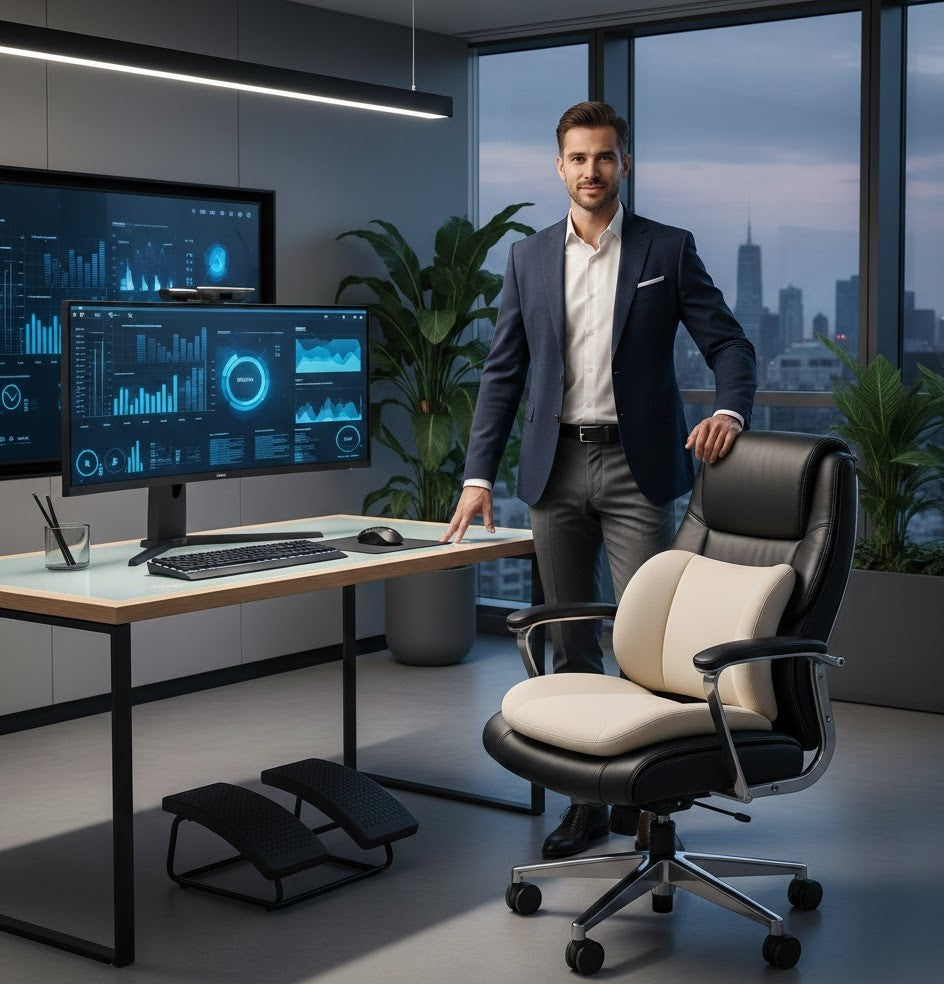
Sitting Comfort: Why You Can Feel Comfortable and Still Be Causing Back Pain
It’s a surprisingly common experience in desk-based work:
You sit down.
Your chair feels comfortable.
There’s no discomfort while you’re working.
And yet, hours later—or at the end of the day—your back aches.
This disconnect often sends people searching for other explanations. Stress, age, lack of stretching, or “poor posture” are common assumptions. When sitting itself feels fine, it’s natural to rule it out as the cause.
But in many cases, the explanation is both simpler and more counterintuitive.
Comfort on its own does not protect the back. While a comfortable seat can reduce immediate pressure and make sitting feel easier, it does not necessarily provide the structural support the body needs over long periods. In fact, comfort can sometimes mask subtle mechanical strain, allowing it to accumulate unnoticed throughout the day.
When that happens, discomfort doesn’t appear during the activity—it shows up later, once the effects of sustained, unsupported sitting begin to surface. What initially feels comfortable can become uncomfortable after prolonged sitting, highlighting the importance of proper support for sitting comfort.
Why Nothing Feels Wrong While You’re Sitting
If back discomfort tends to appear after long periods of sitting—rather than during them—you’re not misinterpreting your body’s signals. This pattern is a common feature of sitting-related back pain.
Soft seating materials are specifically designed to minimize sensation. Cushions, padding, and plush chair surfaces distribute pressure across a wider area, which reduces localized discomfort and makes sitting feel easier in the moment. These materials help make sitting feel comfy, even if the underlying strain is still present. However, a reduction in sensation is not the same as a reduction in mechanical load.
While you sit, your spine, intervertebral discs, and supporting muscles continue to bear sustained forces. If the pelvis is allowed to tilt or the lower back lacks consistent support, those structures must compensate continuously. As noted by UCLA Health, ‘poor sitting posture … can overstretch the spinal ligaments and strain the spinal discs’ when seated for prolonged periods. The key distinction is that the nervous system does not always perceive this low-level strain as a problem in real time.
As a result:
-
Sitting can feel comfortable for extended periods
-
Discomfort may emerge later in the day or the following morning
-
Pain tends to build gradually rather than presenting as a sharp or immediate signal
This delayed response is one of the primary reasons desk-related back pain is frequently misunderstood. Because nothing feels wrong while the activity is happening, sitting is often overlooked as a contributing factor—allowing the underlying strain to persist unchecked.

Comfort and Support Aren’t the Same Thing
In everyday conversation, comfort and support are often used as if they mean the same thing. From an ergonomic standpoint, however, they describe very different functions—and understanding that difference is essential to understanding why back pain can develop even in a “comfortable” setup.
Comfort is primarily about immediate sensory experience. It reflects how a surface feels when you first sit down and is influenced by factors such as:
-
Softness and cushioning
-
Pressure relief at points of contact
-
A general sense of ease or relaxation
These qualities can make sitting more pleasant in the short term, but they don’t determine how well your body is being positioned or stabilized.
Support, on the other hand, is about how your body is held over time. Effective support focuses on:
-
Maintaining pelvic stability
-
Preserving natural spinal alignment
-
Distributing load across muscles and joints rather than concentrating it in one area
Proper support is crucial for healthy sitting, as it helps prevent pressure points, maintains good posture, and reduces discomfort or pain in the tailbone, hips, and back.
Because these two concepts operate differently, a chair or cushion can feel comfortable while still allowing problematic mechanics to persist. For example, it may permit:
-
The pelvis to gradually tilt backward
-
The natural curve of the lower back to flatten or collapse
-
Postural muscles to remain subtly engaged for hours at a time
This is why a seating setup can feel pleasant during use yet still contribute to back pain over the course of the day. Comfort influences how sitting feels in the moment. Support determines how sitting affects your body over time.
Cushions with great support can make a significant difference in long-term comfort.

The Role of Seat Cushions
A well-chosen seat cushion can make all the difference in your daily comfort and long-term back health. An ergonomic seat cushion is designed not just for softness, but for balanced support that helps maintain an upright posture and proper spinal alignment. By cradling your hips and tailbone, a great seat cushion relieves pressure in the areas most prone to discomfort during extended sitting.
Consistent support from a quality seat cushion encourages you to sit comfortably for longer periods, whether you’re at your desk, dining room table, or in your favorite chair. Look for features like a firm support core, a grippy bottom to keep the cushion in place, and a washable cover for easy care. These details ensure your cushion remains supportive, hygienic, and stable—so you can focus on your work or relaxation without constantly adjusting your seat.
Ultimately, the right seat cushion bridges the gap between comfort and structure, helping you maintain healthy posture and reducing the risk of back pain, even when sitting feels effortless in the moment.

How Soft Seating Can Quiet Pain Signals—Without Reducing Strain
Soft seating often gives the impression of being highly supportive because it spreads pressure across a larger surface area. This distribution can reduce sharp or localized discomfort, making sitting feel easier and more forgiving. However, while sensation is reduced, the underlying forces acting on the body do not necessarily decrease. Ergonomic research notes that ‘posture, pressure at interface, and load distribution’ are interrelated factors in comfort perception — indicating that reduced pressure sensation doesn’t always mean reduced mechanical loading on the body.
In many cases, very soft seating can actually introduce new mechanical challenges. It may:
-
Allow the pelvis to sink deeper into the seat
-
Encourage increased rounding of the lower back
-
Shift a greater share of load into spinal tissues rather than distributing it through muscles and supportive structures
To compensate for the lack of support, users may need to adjust their seating position or cushion to achieve better sitting comfort.
Over time, this creates a subtle but important mismatch between how sitting feels and what the body is experiencing. The cushioning dampens discomfort signals, yet the musculoskeletal system continues to work to stabilize unsupported positions.
As a result, the body may be under sustained strain without generating immediate warning signs. Because the sensation of effort is muted, the strain often goes unnoticed—until it accumulates enough to produce stiffness, fatigue, or pain later on.
This disconnect explains why many people report a frustrating pattern: their chair feels comfortable, yet their back symptoms continue to worsen over time.

Pressure Relief Solutions
If you spend long periods sitting, a pressure relief seat cushion can be a game-changer for your comfort and well-being. These cushions are specifically designed to distribute your body weight evenly, helping to relieve pain and discomfort in sensitive areas like the neck, tailbone, and lower back. By reducing concentrated pressure, a relief seat cushion can help prevent the aches and stiffness that often follow hours of sitting.
When searching for the perfect cushion, consider options made with memory foam, which adapts to your body’s contours for customized support. The right balance of softness and firmness is key—too soft, and you may sink in without support; too firm, and you lose the plush comfort that makes sitting enjoyable. Adjustable features can also help you fine-tune your cushion for maximum relief, ensuring you stay comfortable and supported throughout your day.
With a quality pressure relief seat cushion, you can focus on your tasks, knowing your seat is working to relieve pain and protect your body from the strain of prolonged sitting.

Memory Foam Benefits
Memory foam has become a favorite material for seat cushions, and for good reason. A memory foam seat cushion molds to your body’s unique shape, providing personalized support that relieves pressure points and promotes healthy spinal alignment. This adaptability makes memory foam an excellent choice for anyone seeking the perfect cushion for long periods of sitting.
Beyond comfort, memory foam cushions are known for their durability and ability to maintain their supportive qualities over time. When selecting a memory foam seat cushion, pay attention to the density and softness—these factors determine how well the cushion supports your weight and how comfortable it feels. Breathability is also important, as it helps keep you cool and comfortable throughout the day.
With the right memory foam seat cushion, you can enjoy a blend of softness and support that keeps you sitting comfortably and protects your back from unnecessary strain.

The Science of Cushions
The science behind a great seat cushion is all about optimizing support, comfort, and pressure relief for your body. An ergonomic seat cushion is engineered to encourage correct sitting posture, promote upright position, and provide consistent support for your sit bones, hips, and spine. Whether you’re using a pressure relief seat cushion at your office chair, a car seat cushion for your commute, or a back relief lumbar pillow at your desk chair, the goal is the same: to relieve pressure and maintain spinal alignment for ultimate comfort.
Materials like memory foam and gel are chosen for their ability to adapt to your body’s contours, offering both firm support and plush softness. Features such as a grippy bottom, washable cover, and the right cushion height and width ensure your cushion stays in place and fits your chair, whether at the dining room table, office, or car. Lumbar support pillows and relief lumbar pillows add extra support for the lower back, helping to relieve pain and prevent low back pain, sciatica, and tailbone pain.
By understanding the science of cushions—including how they distribute weight, support the spine, and reduce discomfort—you can select the perfect cushion for your needs. With positive reviews and proven results, investing in a well-designed seat cushion can transform your daily sitting experience, turning any chair into your personal throne for extended periods of comfort and support.

Why Posture Effort Fails in Comfortable Setups
When back discomfort begins to surface, posture advice is often the first response. Common guidance sounds familiar: sit up straighter, engage your core, avoid slouching. While well intentioned, this advice assumes that maintaining posture is primarily a matter of awareness and effort.
In practice, comfortable seating setups frequently make posture harder to sustain.
Soft or poorly structured seating places much of the stabilizing demand on the body itself. Instead of being supported by the chair or cushion, the pelvis and spine rely on continuous muscular effort to stay aligned. Over time, this leads to predictable outcomes:
-
Postural muscles fatigue
-
Alignment gradually slips without conscious awareness
-
Repeated self-correction becomes mentally and physically draining
This pattern is not a failure of discipline or attention. It is a mechanical limitation of the environment. When the seating surface does not provide adequate structure, the body compensates by working harder—often without clear feedback in the moment.
Posture-based strategies depend on sustained effort. Support-based solutions reduce the need for effort altogether. When a seating setup holds the pelvis and spine in a more neutral position automatically, alignment becomes the default rather than a task. At that point, posture no longer requires constant monitoring—it is maintained passively, in the background. For some, when sitting comfort becomes too difficult to achieve, choosing to stand can be an alternative, especially if other ergonomic solutions are not available.

The Real Problem: Unsupported Sitting Mechanics
Back pain related to sitting is rarely the result of a single, obvious mistake. More often, it develops through small mechanical issues that repeat for hours each day and accumulate over time. Because these changes happen gradually, they can be easy to overlook—especially when sitting feels comfortable in the moment.
Some of the most common mechanical contributors include:
- Posterior pelvic tilt, where the pelvis gradually rolls backward rather than remaining neutral
- Loss of the natural lumbar curve, increasing stress on spinal structures
- Uneven pressure distribution through the hips and spine, leading to localized overload
- Insufficient grounding through the feet and lower body, which reduces overall postural stability
These factors are interconnected. When one area lacks adequate support, others are forced to compensate. Muscles remain subtly engaged to maintain balance. Joints and connective tissues absorb more load than they are designed to handle for prolonged periods. Over time, this compensation can lead to stiffness, fatigue, and irritation. Poor seating mechanics can also affect the positioning of the knees, potentially leading to discomfort during prolonged sitting.
Importantly, this process does not occur because you are sitting “incorrectly.” It occurs because the seating environment is not providing the structure needed to support neutral mechanics consistently. When the body is not held well, it must work harder simply to remain upright—and it is this ongoing effort that often underlies sitting-related back pain.

What Changes When Sitting Is Structured, Not Just Soft
When sitting support is designed around structure rather than softness alone, the effects are often subtle—but significant. Instead of relying on constant muscular effort to maintain alignment, the body is supported in a way that allows it to settle into a more efficient, sustainable position.
With structured support in place:
-
Load is distributed more evenly rather than concentrated in a few areas
-
Postural muscles are able to relax instead of remaining in a state of low-level bracing
-
The pelvis is more likely to remain in a neutral position, supporting natural spinal alignment
-
Sitting endurance improves, not through effort, but through reduced strain
This is where thoughtfully designed ergonomic cushions play an important role. Rather than functioning as simple padding, they provide a stable foundation that supports the pelvis consistently over time. However, not all the cushions available on the market offer the same level of structured support—some prioritize softness over stability, which can impact long-term sitting comfort.
The Serenform Summit Seat Cushion is designed with this principle in mind. It offers structured support beneath the pelvis while still maintaining comfort, helping to prevent the unpredictable sinking that can occur with very soft seating. By promoting more consistent alignment, it helps reduce the prolonged mechanical strain that often accompanies long sitting sessions.
The objective is not to make sitting feel rigid or restrictive. It is to create a sense of support that works in the background—so sitting feels stable, calm, and effortless rather than something that requires constant adjustment.

Why True Ergonomic Support Works Even When You Forget About It
The most effective ergonomic solutions are often the least noticeable. Rather than demanding ongoing attention, they function quietly in the background, allowing the body to remain supported without conscious effort. For example, a lumbar support pillow can provide passive support to the lower back, enhancing sitting comfort without requiring you to think about your posture.
Well-designed support does not rely on:
-
Constant posture monitoring
-
Reminders or cues throughout the day
-
Sustained willpower or active correction
Instead, it changes the physical conditions your body is working within. By providing consistent structural support, it reduces the need for compensation and allows the musculoskeletal system to operate more efficiently.
When adequate support is in place:
-
Sitting feels more stable and calm
-
Overall effort decreases, even during long work sessions
-
Strain is less likely to accumulate unnoticed over time
This is the distinction between short-term comfort and long-term relief. Temporary comfort may make sitting feel easier in the moment, but effective support addresses the underlying mechanics that influence how your body responds to sitting hour after hour. Rather than working against your body, true ergonomic support works with it—consistently, quietly, and without requiring your attention.

Comfort Isn’t the Enemy—Lack of Structure Is
Comfort itself is not the problem. In fact, comfort plays an important role in making sitting tolerable and reducing unnecessary pressure in the short term. The issue arises when comfort exists without adequate structure to support the body over time.
It is entirely possible to feel fine while sitting and still place unnecessary strain on the back. When this happens, it is not a sign that you are sitting incorrectly or failing to maintain good habits. Rather, it suggests that the seating setup may be missing the structural support required to maintain healthy mechanics throughout the day.
Without that structure, small misalignments can persist unnoticed. Muscles compensate, tissues absorb more load than they should, and strain accumulates gradually. When structure is introduced—through support that stabilizes the pelvis, preserves alignment, and distributes load—the mechanics of sitting change.
And when mechanics change, outcomes change as well.
Sitting no longer feels like something to endure or manage. Instead, it becomes a neutral, sustainable position that allows your body to remain supported, comfortable, and at ease over extended periods of time.