Memory Foam vs Gel Cushion: Which Should You Choose?
If your daily routine involves extended periods of sitting—whether at a desk, in meetings, or while working from home—you may already be familiar with the gradual onset of discomfort. What often begins as mild pressure can develop into noticeable strain in the lower back, hips, or tailbone over the course of the day. For many, this experience prompts a search for a practical, effective solution.
This is where seat cushions enter the conversation. A great seat cushion is essential for supporting the lower body, alleviating pressure on the lower back, coccyx, and joints, and enhancing comfort in various settings such as office chairs, car seats, or at home.
However, once you begin exploring your options, a more nuanced question quickly arises:
Should you choose a memory foam cushion or a gel cushion?
At first glance, both appear to serve the same purpose. Each is designed to enhance comfort, reduce pressure, and make prolonged sitting more manageable. Yet despite these similarities, the materials function in fundamentally different ways. These differences influence not only how a cushion feels initially, but how it performs over hours of continuous use.
Selecting the right material is therefore not a minor detail—it plays a significant role in determining whether your seating experience improves or remains a source of ongoing discomfort.
In this guide, we will examine:
- How memory foam and gel cushions function in practical use
- Which material is better suited for long sitting sessions and pain relief
- Key differences in comfort, temperature regulation, and durability
- And ultimately, how to choose the option that best aligns with your needs
By understanding these distinctions, you can make a more informed decision—one that supports both your comfort and your long-term well-being.
Let’s begin with the fundamentals.

What Is a Memory Foam Cushion vs. a Gel Cushion?
Before evaluating which option performs better in real-world use, it is important to understand how each material functions at a fundamental level. While both memory foam and gel cushions are designed to improve sitting comfort, they achieve this in very different ways—and those differences directly influence support, pressure relief, and long-term usability.
What Is a Memory Foam Cushion?
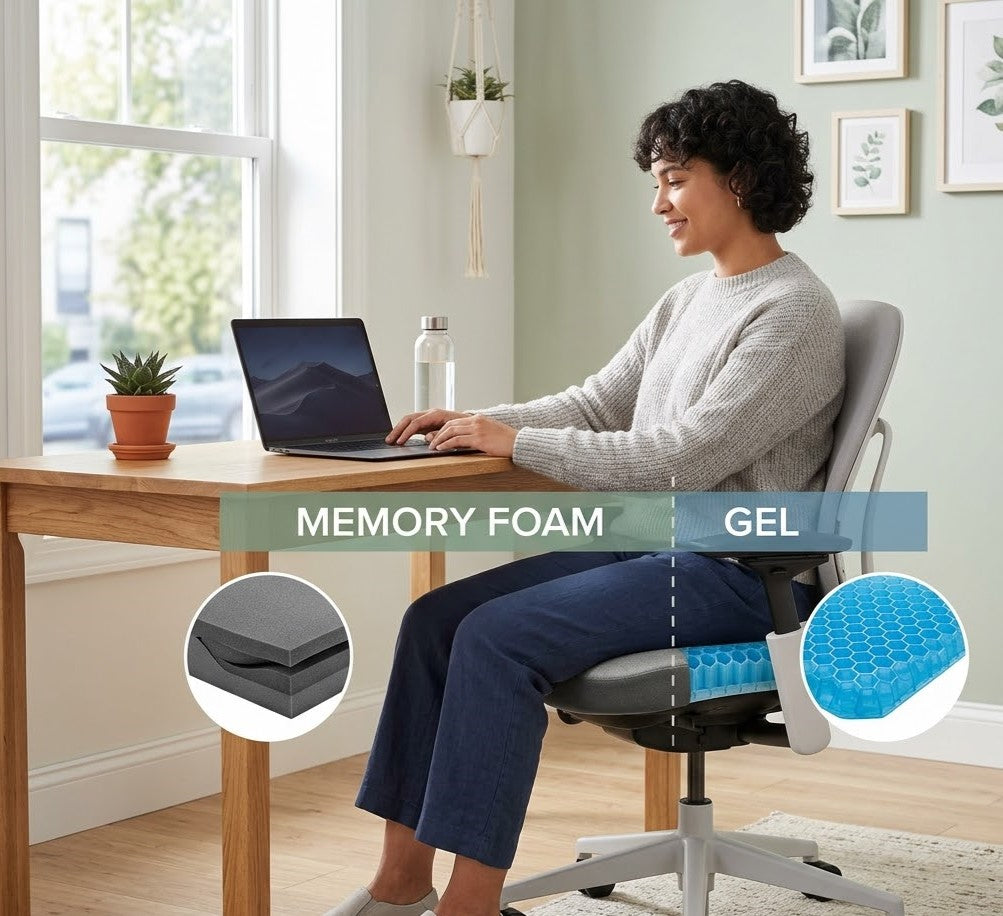
Memory foam is a viscoelastic polyurethane material, also called temper foam, engineered to respond to a combination of body weight and temperature. When pressure is applied—such as when you sit—the foam gradually softens and conforms to the unique shape of your body.
Temper foam was originally developed by NASA for crash protection and is known for its ability to contour to the body, providing both comfort and support.
This adaptive contouring is what distinguishes memory foam from more traditional cushioning materials. Rather than resisting pressure, it redistributes it.
Memory foam's open-cell structure, made up of foam bubbles, allows for some airflow and breathability, which helps regulate temperature and improve comfort.
As a result, memory foam cushions are able to:
- Distribute body weight more evenly across the seating surface
- Reduce pressure concentration on sensitive areas such as the tailbone and hips
- Support natural spinal alignment by adapting to your posture
Once the pressure is removed, the material slowly returns to its original form. This “memory” characteristic allows the cushion to maintain both structure and responsiveness over time. High-density memory foam is denser and can last longer than gel-infused options, providing longer-lasting support and preventing excessive sinking.
Because of these properties, memory foam is widely recommended for:
- Prolonged sitting sessions (6–10+ hours)
- Individuals experiencing lower back or tailbone discomfort
- Those seeking improved postural support and alignment
In practice, memory foam provides a balance of comfort and structure—supporting the body while minimizing the need for constant repositioning.
What Is a Gel Cushion?
Gel cushions are constructed using gel-based layers, inserts, or grid-like (honeycomb) structures, often combined with a foam base for added support. These cushions may incorporate gel beads, gel microbeads, or a top layer of cooling gels, and are sometimes referred to as gel infused cushions or gel infused seat cushions. Gel cushions can contain liquid gel, microbeads, or a top layer of gel on memory foam. Infused memory foam or gel memory foam combines the benefits of both materials, offering enhanced cooling and support.
Unlike memory foam, gel does not contour in the same gradual, adaptive manner. Instead, it responds more immediately to pressure.
Gel cushions are designed to:
- Feel cooler upon contact, due to the thermal properties of gel and the presence of cooling gels or gel microbeads
- Provide a softer, more flexible seating surface
- Promote airflow, depending on the cushion’s structure and design
Gel-infused cushions use cooling particles or a top layer to dissipate warmth and provide springier support. Gel cushions are especially suitable for individuals who frequently overheat or sit in warm environments. Gel is often preferred for high-impact activities because it excels in shock absorption.
When weight is applied, gel cushions tend to:
- Compress directly under pressure
- Redistribute weight more at the surface level, rather than throughout the material
This creates a sensation of softness and light cushioning, which many users find comfortable—particularly during shorter sitting periods or in warmer environments.
However, because gel lacks the same level of contouring and structural support as memory foam, its performance may vary over extended use.
Key Difference (Simplified)
| Feature | Memory Foam Cushion | Gel Cushion |
|---|---|---|
| Response to Pressure |
Gradually contours to body shape |
Compresses directly under weight |
| Type of Support |
Deep, structured support |
Surface-level cushioning |
| Overall Feel | Adaptive, stable, and supportive |
Soft, flexible, and responsive |
Understanding this distinction is essential. The way a cushion interacts with your body—whether it contours and supports or compresses and flexes—has a direct impact on how comfortable it feels not just initially, but after several hours of continuous sitting.
Choosing between memory foam and gel is not simply a matter of preference; it is a decision that influences posture, pressure distribution, and overall sitting experience.

Comfort & Feel: Which Is Better for Long Sitting?
When users search for terms like “memory foam vs gel comfort” or the “best cushion for sitting all day,” they are not simply comparing materials—they are evaluating long-term experience. A supportive seat cushion is essential for maintaining comfort and posture support during long periods of time sitting, helping to alleviate pressure on the lower back and tailbone.
The real question is:
Which cushion will remain comfortable after 6–10 hours of continuous sitting—not just during the first few minutes? Choosing the right seat cushion can help prevent hip pain and lower body discomfort, ensuring proper support and pressure distribution for extended time sitting.
Initial comfort can be misleading. What matters more is how a cushion performs over time, particularly as pressure builds and posture begins to shift. The best seat cushions are those that provide both comfort and support for long durations, promoting healthy posture and reducing fatigue.
Memory Foam: Consistent, Supportive Comfort
Memory foam seat cushions are specifically engineered for extended sitting durations, designed to provide lumbar support and often paired with a lumbar support pillow for enhanced comfort and ergonomic benefit.
Because memory foam gradually conforms to the shape of your body, it creates a more balanced and stable seating foundation. This adaptive response allows the cushion to support your natural posture and maintain the spine’s natural curve, rather than forcing your body to compensate. For those who require additional support, some users may prefer a firmer pillow, which can be achieved with gel-infused or higher-density memory foam designs.
As a result:
- Body weight is distributed evenly, reducing localized strain
- Pressure points are minimized, particularly around the hips and tailbone
- Postural stability and lumbar support improves, reducing the need for constant adjustment
Over time, these effects contribute to a more consistent sitting experience. Instead of frequently shifting positions to relieve discomfort, the body remains supported in a more neutral and sustainable posture.
This leads to:
- Reduced fidgeting and repositioning
- Lower levels of physical fatigue throughout the day
- A more stable and uninterrupted work experience
From a performance perspective, this consistency is significant. When the body is properly supported, less energy is spent compensating for discomfort—allowing for improved focus and sustained productivity.
Gel Cushions: Initially Comfortable, Less Stable Over Time
Gel seat cushions, especially those that are gel infused, often incorporate gel microbeads to increase firmness and enhance cooling properties. These gel microbeads help improve heat dissipation and provide a denser, more supportive feel compared to standard gel-only designs.
They typically provide:
- Immediate softness upon contact
- A slightly responsive or flexible feel, which can be appealing in the short term
This initial comfort is largely due to the material’s ability to compress quickly under pressure. However, this same characteristic can lead to variability during prolonged use.
Over extended sitting periods:
- The gel may shift or redistribute unevenly
- Support can become less consistent, particularly under sustained pressure
- Users may find themselves adjusting position more frequently to maintain comfort
While a gel seat cushion is not inherently uncomfortable, its performance is often better suited to shorter durations or situations where flexibility is prioritized over structured support.
In longer sessions, the lack of deep, adaptive contouring can result in a less stable seating experience.
Comfort Verdict
- For short-term comfort or initial softness → Gel cushions may feel more immediately pleasant
- For extended sitting and sustained support → Memory foam provides a more consistent and reliable experience
Ultimately, long-term comfort is not defined by how a cushion feels in the first few minutes, but by how well it supports your body over time. In this regard, memory foam offers a more dependable solution for individuals who spend significant portions of their day seated.

Pressure Relief & Support: Which One Reduces Pain Better?
When evaluating seat cushions, pressure relief and structural support are among the most critical factors—particularly for individuals experiencing discomfort from prolonged sitting. An ergonomic seat cushion is specifically designed for relieving pressure and providing posture support, especially for the lower body, helping to alleviate hip pain and promote proper spinal alignment.
This is especially true if you’ve searched for:
- “best cushion for tailbone pain”
- “memory foam cushion for back pain”
These searches reflect a need that goes beyond surface comfort. The goal is not simply to feel better temporarily, but to reduce strain, improve alignment, and prevent discomfort from building over time.
Why Pressure Relief Matters
Sitting for extended periods places continuous stress on specific areas of the body. Without adequate support:
- Pressure accumulates in the hips and tailbone, particularly at points of direct contact with the chair
- The spine experiences compression, especially when posture is unsupported and the natural curve of the spine is not maintained
- Muscles in the lower back and core must work harder to maintain stability, especially when upright posture is not encouraged
Supporting the spine's natural curve and promoting a more upright posture are essential for reducing spinal compression and encouraging proper alignment.
Over time, this can contribute to:
- Persistent lower back pain
- Sciatic discomfort, often radiating through the hips or legs
- Increased sensitivity in the coccyx (tailbone)
These issues rarely result from a single moment of poor posture. Instead, they develop gradually through repeated exposure to uneven pressure and inadequate support.
For this reason, effective cushioning must do more than soften the seat—it must actively redistribute pressure and support the body’s natural alignment.
Memory Foam: Engineered for Even Pressure Distribution
Memory foam is specifically designed to address these challenges through its adaptive, contouring properties. Denser memory foam, often found in high-quality seat cushions, provides more consistent support and maintains its shape over time, making it ideal for use as a support cushion during extended periods of sitting.
When weight is applied, the material gradually molds to the body, allowing it to:
- Distribute load evenly across a wider surface area
- Reduce concentrated pressure on the tailbone and hips
- Support the spine in a more neutral, aligned position
This even distribution minimizes the stress placed on any single point, which is essential for preventing discomfort during long sitting sessions.
Because of this, memory foam is particularly effective for:
- Individuals experiencing chronic discomfort from prolonged sitting
- Those managing posture-related strain or spinal fatigue
- Users seeking long-term ergonomic support rather than short-term relief
Over time, this level of support helps reduce the need for muscular compensation, allowing the body to remain more relaxed and stable throughout the day.
Gel Cushions: Surface-Level Pressure Relief
Gel cushions also offer pressure-reducing properties, but they function in a different way.
They are designed to:
- Absorb initial impact at the surface level
- Provide a layer of cushioning that can feel comfortable under immediate pressure
- Deliver excellent shock absorption, making them especially valued for use on hard seating surfaces like stadium benches or outdoor event chairs
Gel excels in shock absorption, helping to reduce the impact from bumpy roads or uneven surfaces, while memory foam is better for custom molding in specialized uses such as insoles.
This can help alleviate discomfort in the short term. However, the relief tends to remain closer to the surface rather than extending through the full depth of the material.
As a result:
- Deeper structural support is often limited
- Pressure may gradually reconcentrate in key areas, particularly during extended use
- The body may still need to adjust or compensate to maintain posture over time
While gel cushions can improve initial comfort, they may not provide the same level of sustained pressure distribution required for individuals dealing with ongoing pain or long-duration sitting.
Pressure Relief Verdict
If your primary objective is meaningful pain relief, improved posture, and consistent support over time, memory foam is generally the more effective and reliable choice.
Its ability to adapt to the body and evenly distribute pressure makes it particularly well-suited for individuals who spend extended hours seated or who are seeking a more durable ergonomic solution.

Cooling & Breathability: Do Gel Cushions Stay Cooler?
Temperature is an often overlooked—but highly influential—factor in sitting comfort. For individuals who spend extended hours seated, even slight heat buildup can lead to discomfort, restlessness, and reduced focus over time.
Cooling gels and open-cell foam bubbles are specifically designed to help the material stay cool and prevent it from trapping heat. These features improve breathability and temperature regulation, making cushions more comfortable for long periods.
It’s no surprise that many users search for:
- “does memory foam get hot?”
- “cooling seat cushion for long sitting”
These concerns highlight an important aspect of cushion performance: how well the material regulates heat and allows airflow during prolonged use.
Why Temperature Matters in Sitting Comfort
When you remain seated for long periods:
- Body heat naturally transfers into the cushion
- Limited airflow between the body and seat can trap warmth
- Moisture and heat buildup can lead to discomfort and distraction
Over time, this can result in:
- A feeling of stickiness or overheating
- Increased need to shift positions
- Reduced overall sitting tolerance
An effective cushion should therefore not only provide support, but also help maintain a comfortable thermal environment.
Gel Cushions: Naturally Cooler—At Least Initially
A gel infused seat cushion uses cooling gels or gel infused technology—such as cooling particles or a top layer—to dissipate warmth and provide springier, firmer support compared to traditional memory foam. Gel cushions are widely recognized for their cooling properties, primarily due to the thermal characteristics of the gel material itself.
They tend to:
- Dissipate heat more efficiently than traditional foam, thanks to the presence of cooling gels or gel-infused layers
- Feel cooler upon initial contact
- In some designs, allow airflow through open or grid-like structures
As a result:
- Users often experience an immediate sensation of coolness when sitting down
- Short-term heat buildup may be reduced
This makes gel cushions, especially gel-infused seat cushions, particularly appealing in:
- Warmer climates
- Non-air-conditioned environments
- Situations where initial cooling comfort is a priority
However, it is important to note that this cooling effect is often most noticeable at the beginning of use. Over time, as body heat continues to transfer into the material, the temperature difference may become less pronounced.
Memory Foam: Warmer by Nature, but Design Matters
Traditional memory foam has a tendency to trap heat, as its dense structure limits airflow and absorbs body warmth. However, open-cell foam bubbles and breathable fabric covers are now used to help the material stay cool by improving air circulation and reducing heat retention.
Modern ergonomic designs have evolved to address this limitation. Many high-quality memory foam cushions now incorporate features such as:
- Breathable fabric covers that enhance air circulation
- Ventilation channels or perforations within the foam
- Temperature-neutral or open-cell foam structures designed to reduce heat retention
With these enhancements, memory foam cushions can provide a more balanced thermal experience—while still maintaining their core advantage: consistent, structured support.
While memory foam may feel slightly warmer compared to gel, it offers:
- Greater stability over long periods
- Less need for repositioning due to discomfort
- A more consistent overall sitting experience
Cooling Verdict
- For an immediate cool-to-the-touch sensation → Gel cushions offer a noticeable advantage
- For balanced, all-day comfort with managed heat → Memory foam (especially with breathable design) provides a more consistent experience
Ultimately, while cooling is an important factor, it should be considered alongside support and pressure relief. A cushion that feels cool initially but lacks long-term stability may not deliver the sustained comfort required for extended sitting.

Durability & Longevity: Which Cushion Lasts Longer?
When evaluating seat cushions, comfort is often the initial priority—but durability is what determines whether that comfort lasts. Cushions made with high quality materials are more likely to retain their shape and functionality over time, contributing to both longevity and consistent performance. For individuals who rely on a cushion daily, the more important question becomes:
Which option will continue to provide consistent support months—or even years—from now?
A cushion that performs well initially but degrades quickly can lead to renewed discomfort and the need for frequent replacement. For this reason, material longevity is a key factor in both cost-effectiveness and long-term ergonomic benefit. Proper maintenance, including regular cleaning and storing cushions in a dry place, also helps prevent mold and mildew and extends the life of your seat cushion.
Memory Foam: Engineered for Long-Term Performance
High-quality memory foam—particularly high-density variants—is designed with durability in mind.
Its structure allows it to:
- Retain its original shape over extended use
- Resist compression and flattening, even under daily pressure
- Maintain consistent support and contouring properties over time
Because memory foam gradually adapts rather than collapsing under weight, it is better equipped to withstand repeated use without significant loss of performance.
This makes it particularly well-suited for:
- Individuals who sit for extended periods each day (6–10+ hours)
- Work-from-home or office environments requiring reliable daily support
- Those seeking a long-term ergonomic investment, rather than a temporary solution
Over time, a well-constructed memory foam cushion continues to deliver the same level of support it provided when new—helping preserve both comfort and posture. Proper maintenance, including regular cleaning and storing cushions in a dry place, also helps prevent mold and mildew and extends the life of your seat cushion.
Gel Cushions: More Variable Durability
Gel cushions, while effective in certain aspects of comfort, tend to exhibit greater variability in long-term performance depending on their design and usage. The durability of a gel infused cushion, in particular, may vary based on the specific materials and construction methods used.
Common durability considerations include:
- The gel material may shift or redistribute unevenly over time
- Some designs are more prone to localized compression, especially under consistent pressure
- Structural integrity can gradually decline, particularly with heavy or prolonged use
In some cases, this can lead to:
- Reduced support in key areas
- A less stable seating surface
- The need for more frequent replacement compared to higher-density foam alternatives
While gel cushions, including gel infused cushion types, can perform well initially, their long-term resilience is often less predictable—especially in high-use scenarios.
Durability Verdict
For individuals prioritizing long-term value, consistent support, and sustained performance, memory foam is generally the more reliable and durable choice.
Its ability to maintain structure under continuous use makes it a more dependable option for daily seating—particularly in professional or home office environments where comfort must be sustained over time.

Quick Comparison: Memory Foam vs. Gel Cushions
After examining each factor in detail—comfort, pressure relief, cooling, and durability—it can be helpful to view the differences side by side. A clear comparison allows you to evaluate which material aligns more closely with your priorities, particularly if you are deciding between immediate comfort and long-term support.
The table below summarizes how memory foam and gel cushions typically perform across the most important criteria for everyday use:
| Feature | Memory Foam Cushion | Gel Cushion |
|---|---|---|
| Long Sitting Comfort |
✅ Excellent — consistent support over extended periods |
⚠️ Moderate — comfortable initially, may vary over time |
| Pressure Relief |
✅ High — evenly distributes weight and reduces strain |
⚠️ Medium — provides surface-level cushioning |
| Cooling & Breathability | ⚠️ Moderate — depends on design and materials used |
✅ High — cooler to the touch, better initial airflow |
| Durability | ✅ Long-lasting — retains shape and support | ⚠️ Variable — may shift or degrade with prolonged use |
| Support & Stability | ✅ Strong — promotes alignment and posture | ⚠️ Limited — less structured support over time |
How to Interpret This Comparison
While both materials offer advantages, the key distinction lies in how they perform over time.
- Memory foam is designed to provide consistent, structured support, making it particularly effective for long hours of sitting and ongoing discomfort management.
- Gel cushions, on the other hand, emphasize initial comfort and cooling, which can be beneficial in specific environments but may not deliver the same level of sustained support.
For most users—especially those working long hours at a desk—the combination of pressure relief, stability, and durability tends to have a greater impact on overall comfort than cooling alone.
This comparison is not intended to suggest that one material is universally superior in every scenario, but rather to clarify which option is better suited for long-term ergonomic performance versus short-term comfort preferences.

Which Cushion Should You Choose?
After comparing memory foam and gel cushions across comfort, pressure relief, cooling, and durability, the decision ultimately comes down to how you intend to use the cushion—and what outcomes matter most to you. Choosing a new seat cushion for your desk chair or office chair can make a significant difference in comfort and support, especially if you spend long hours sitting.
While both materials offer benefits, they are designed with different priorities in mind. Seat cushion choosing should be based on your individual needs, the type of chair you use—whether it's an office chair, desk chair, or another seating option—and the level of support and alignment you require. Clarifying your primary need can make the selection process more straightforward.
A Simple Way to Decide
Based on common use cases:
- For back pain or tailbone discomfort → Memory foam
Designed to redistribute pressure and support proper alignment, making it more effective for reducing strain over time. - For long work hours (6–10+ hours sitting) → Memory foam
Provides consistent support that helps minimize fatigue and the need for frequent repositioning. - For long-term value and durability → Memory foam
Retains shape and performance more reliably with daily use.
The Key Consideration
When evaluating these options, it is important to look beyond immediate comfort and consider how the cushion will perform over extended periods of use.
If your priority is:
- Consistent, all-day support
- Reduced physical fatigue during prolonged sitting
- Improved posture and alignment
Memory foam is generally the more reliable and well-rounded choice for most users.
Its ability to adapt to the body while maintaining structure makes it particularly suitable for individuals who spend significant time seated—whether in a home office, corporate environment, or hybrid setup.
A Practical Perspective
While gel cushions can enhance comfort in specific scenarios—particularly where cooling is a primary concern—most users benefit more from a solution that addresses the underlying causes of discomfort: uneven pressure distribution and lack of support.
In this context, memory foam offers a more comprehensive approach to ergonomic sitting—supporting not just how you feel initially, but how you feel after hours of continuous use.

Why Serenform Recommends Memory Foam
At Serenform, our approach to ergonomics is guided by a clear principle:
Comfort should not be temporary—it should be sustainable throughout the entire workday.
Many seating solutions offer short-term relief, but fail to provide the level of support required for prolonged use. Over time, this gap between initial comfort and sustained performance becomes increasingly noticeable. For this reason, material selection is not just a design choice—it is a critical factor in long-term user experience. Using high quality materials ensures that a cushion retains its shape and functionality, providing proper support and spinal alignment during long periods of sitting.
This is why products such as the Serenform Summit Seat Cushion are developed using high-quality, performance-driven memory foam, specifically engineered to meet the demands of real-world sitting conditions.
Designed for Real-World Use
Unlike generic cushions that prioritize softness alone, Serenform’s design approach focuses on how the body interacts with the seat over extended periods.
Key priorities include:
- Targeted pressure relief, particularly in high-stress areas such as the tailbone and hips
- Consistent structural support, helping maintain proper posture throughout the day
- Shape retention and durability, ensuring the cushion performs reliably with daily use
This combination allows the cushion to function not merely as a comfort accessory, but as a support system that actively improves the sitting experience.
Beyond Softness: A More Supported Sitting Experience
A common misconception is that a softer cushion automatically equates to greater comfort. In practice, comfort is determined by how well the body is supported over time, not just how it feels initially.
By focusing on pressure distribution and alignment, memory foam enables:
- A more balanced seating position
- Reduced strain on the lower back and hips
- Less reliance on constant posture adjustments
The result is not simply a softer surface, but a more stable and ergonomically aligned sitting posture.
The Impact Over a Full Workday
For professionals who spend hours at a desk, these differences become increasingly apparent as the day progresses.
With proper support in place:
- Movement becomes more intentional, rather than driven by discomfort
- Physical fatigue is reduced, particularly in the lower back and core
- Focus is easier to maintain, as fewer distractions arise from shifting or strain
Over time, this translates into a more consistent and sustainable work experience—one where comfort supports productivity, rather than limiting it.
Serenform’s recommendation of memory foam is therefore not based on preference alone, but on its ability to deliver reliable, long-term ergonomic support in the environments where it matters most.

Conclusion: The Right Cushion Comes Down to Support
When comparing memory foam cushions vs. gel cushions, it is easy to focus on surface-level features—such as initial softness or cooling sensation. While these factors do contribute to comfort, they do not fully determine how a cushion performs over time.
The more important question is:
How effectively does the cushion support your body throughout the entire day?
This is where the distinction becomes clear.
Gel cushions can offer a noticeably cooler and softer feel at the outset, which may enhance short-term comfort. However, for prolonged sitting, performance depends less on initial sensation and more on how consistently the material maintains support under continuous use.
Memory foam, by design, addresses this need more comprehensively. It provides:
-
More effective pressure distribution, reducing strain on the hips and tailbone
-
Consistent structural support, helping maintain proper posture over time
-
Greater durability, allowing the cushion to retain its performance with regular use
For most individuals—particularly those who spend extended hours seated—these factors contribute to a significantly improved sitting experience.
Why Support Matters Over Time
When the body is properly supported:
-
Sitting requires less physical effort to maintain posture
-
Discomfort is reduced, rather than gradually accumulating
-
Focus becomes easier to sustain, with fewer interruptions from shifting or strain
Over the course of a workday, these benefits compound. What might seem like a small improvement in comfort can translate into greater consistency, reduced fatigue, and improved overall productivity.
A More Sustainable Sitting Experience
Ultimately, the goal of an ergonomic cushion is not simply to make sitting feel better in the moment—it is to make it more sustainable over time.
By prioritizing support, alignment, and durability, memory foam provides a solution that extends beyond temporary relief and contributes to long-term comfort.
If you are looking to improve how you sit—and how you feel throughout the day—choosing the right foundation is essential.
👉 Explore the Serenform Summit Seat Cushion and experience the difference of properly supported comfort.